

Taking five months before the development of an app was the norm, as it required a large team, thousands of lines of code and then a wait. Not anymore. AI software developers have redefined the game. Nowadays, a single founder with an awesome idea can create a real functioning application, even without extensive knowledge of code. These AI App Builder Platforms are based on intelligent visual tools, drag-and-drop editors, and AI-based functionality to accelerate the whole process. The 10 best AI App Builder Platforms of 2026 are in this guide. You might be looking to create a mobile application, a web tool or an internal dashboard, and you will find something here. We will identify the suitable one.
What is an AI App Builder?
An AI app builder is a software platform that provides the ability to develop web or mobile apps on a visual platform, powered by artificial intelligence, and without much or any technical programming. You do not have to write all the code on your own, but instead just drag and drop something, explain what you want, and the AI builds it. These AI App Builder Platforms deal with designing, logic, databases and even deployment, making the creation of apps quicker and accessible to all.
Why AI App Builder Platforms Are Trending in 2026
- No-code is becoming a standard practice – More companies are creating applications with no one on the development team.
- Faster than light AI accelerates it all – AI reduces the time to write a screen, write logic, or build time by an hour.
- Startups require rapidity – AI App Builder Platforms enable creators to test concepts and introduce MVPs in days, as opposed to months.
- The cost savings are enormous – 400,000 it would cost to hire a dev, but it would still be affordable to build. Skipping expensive dev hires.
- The integrations have become painless – Modern AI App Builder Platforms integrate without any issues with databases, APIs and third-party tools.
Top 10 AI App Builder Platforms for Beginners
1. WeWeb
Rating: 4.7 / 5
Website: https://www.weweb.io/
Best For: Building pixel-perfect web front ends with full code export freedom.
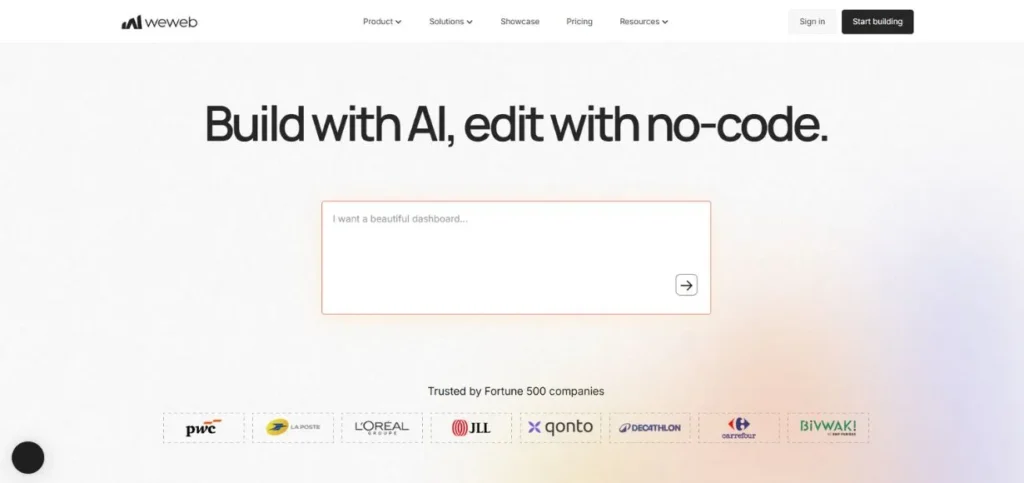
WeWeb is an easy-to-use visual front-end builder designed to allow teams to retain full control of the design while maintaining code ownership. You integrate your own backend, such as Supabase or Xano, and WeWeb is the one taking care of the beautiful responsive UI. The best thing is that it exports clean Vue.js code and, therefore, you are never locked in. It also possesses artificial intelligence tools that assist in creating the components and scaffold your application more quickly. WeWeb is a good choice, in case the quality of the design and long-term flexibility are important to you.
Key Features
- Visual front-end editor
- REST & GraphQL connectors
- Vue.js code export
- AI component generation
- Staging & rollback support
Pros
- Clean code export
- Great design control
- Backend flexibility
Cons
- No built-in backend
- Some plugins break after export
- Web only, no native apps
Pricing: Free
Also Read: Best Application Security Testing Tools
2. Bubble
Rating: 4.6 / 5
Website: https://www.bubble.io/
Best For: Building full-stack apps fast without a backend team
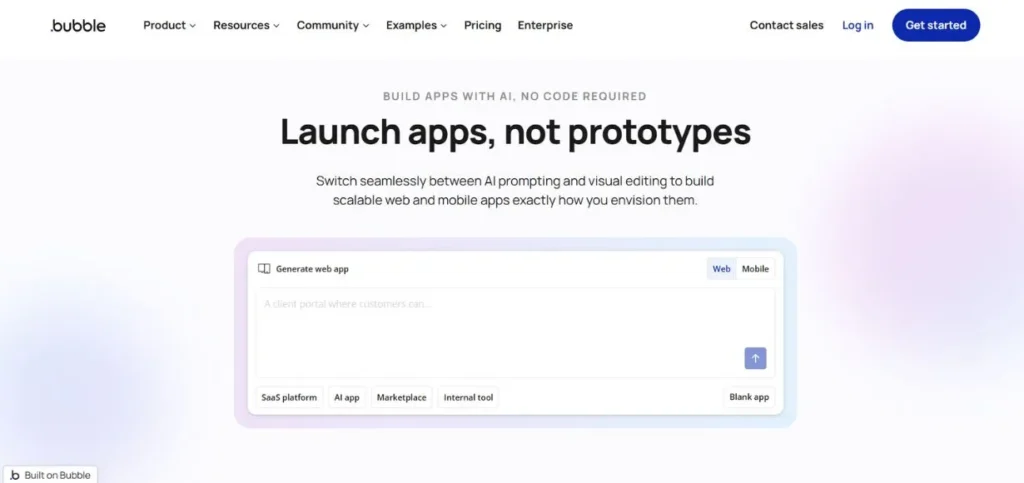
Bubble belongs to the group of the most popular no-code platforms that have good reasons. It provides you with a single location: UI design, workflow, a database, and hosting. You are able to develop serious applications that are heavy on logic without writing a single line of code. Bubble also has an AI App Generator to make it even easier to start. It is iOS and Android distribution supported and compliant with SOC 2 Type II that is terrific when dealing with security-conscious teams. A little bit of learning is required, but the amount of power you can achieve is worth it.
Key Features
- Responsive visual editor
- Built-in database
- iOS & Android support
- SOC 2 Type II security
- AI App Generator
Pros
- All-in-one platform
- Strong security features
- Mobile app support
Cons
- Steep learning curve
- No code export
- Usage costs can spike
Pricing: Free
3. FlutterFlow
Rating: 4.7 / 5
Website: https://www.flutterflow.io/
Best For: Building native mobile and web apps with real code ownership
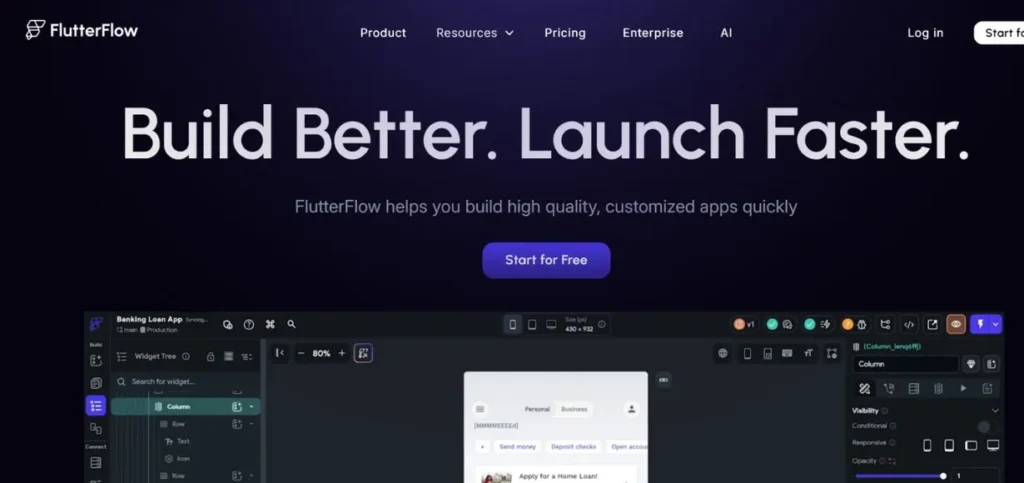
FlutterFlow is the preferred choice when a team would like to develop native apps quickly, but retain control over the codebase. You build your app with your fingers, connect your data and then, when you feel like it, export production Flutter code. It is compatible with Firebase, Supabase and any REST API. It also has AI that creates screens using basic prompts or even Figma designs. When the speed of no-code and the freedom of real code are in demand, FlutterFlow balances that quite well.
Key Features
- Native iOS & Android output
- Firebase & Supabase support
- Flutter code export
- AI screen generation
- GitHub CI/CD integration
Pros
- True code ownership
- Native app quality
- Great AI features
Cons
- Dart knowledge needed
- Outside edits are not re-importable
- Weak SEO for web apps
Pricing: Free
4. Adalo
Rating: 4.4 / 5
Website: https://www.adalo.com/
Best For: Quickly publishing mobile apps to the App Store and Play Store
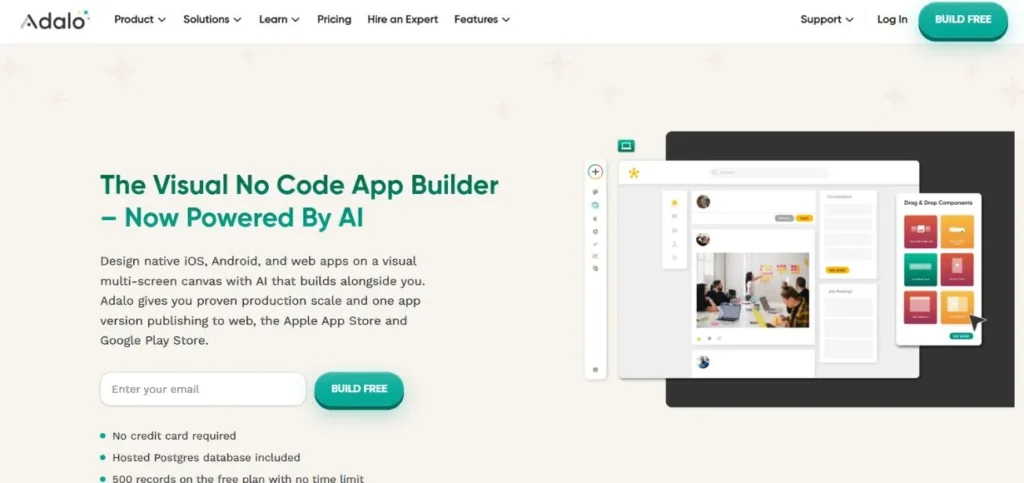
To have a mobile app published within the minimal amount of time, Adalo is the ideal choice. Its editor is not very complex and easy to pick and use, even when you have never built an app before. Publishing to Apple, Google and the web is all on the same project. Adalo includes its own database, although there is the ability to connect to outside services such as Airtable or Xano. Marketplace components have also enabled you to add AI features to your app. To start small and fast MVPs and simple applications, Adalo is an excellent place to start.
Key Features
- Publish to iOS, Android & Web
- Freeform mobile editor
- REST API connections
- Component marketplace
- Generative AI features
Pros
- Very easy to start
- Multi-platform publishing
- No infrastructure needed
Cons
- No code export
- Limited offline features
- Action-based usage costs
Pricing: Free
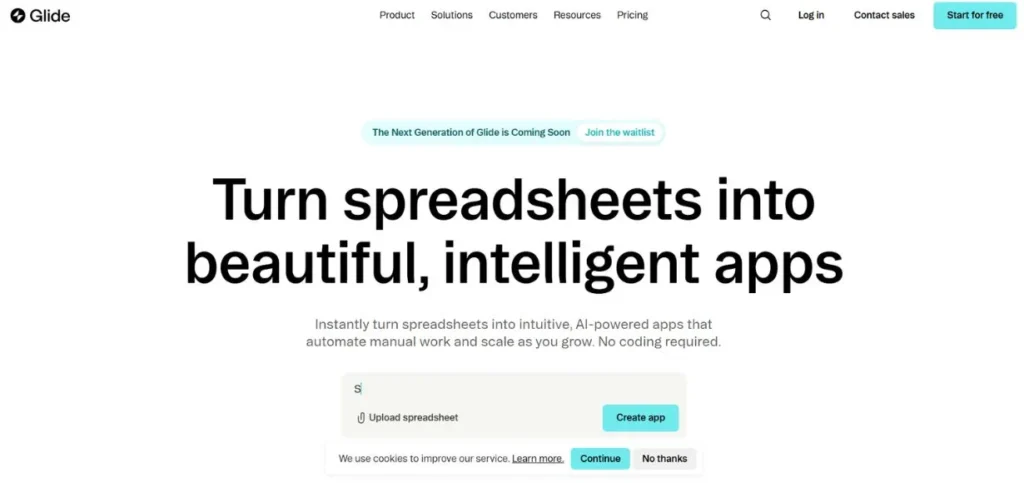
5. Glide
Rating: 4.5 / 5
Website: https://www.glideapps.com/
Best For: Turning spreadsheets or SQL data into polished web apps fast
Glide is the most intelligent tool. In case you already have some data in Google Sheets, Airtable, or a SQL database and need to transform it into an operational app without having to redo everything. It is particularly favoured with the internal tools, client portals, and field operations. The Big Tables of Glide are surprisingly powerful, with the ability to work with more than 10 million rows. It also has AI text processing, OCR and audio transcription blocks. Security is enterprise-level with SOC 2 Type II and SSO. Your app can be live in a very second if your data is ready.
Key Features
- Integrated data editor
- AI blocks (OCR, text, audio)
- Big Tables (10M+ rows)
- SOC 2 Type II & SSO
- SQL read/write support
Pros
- Super fast data-to-app
- Enterprise-level security
- Handles large data sets
Cons
- PWA only, no native apps
- No UI export available
- Metered usage updates
Pricing: Free
Want to read? Rapid Web App Development
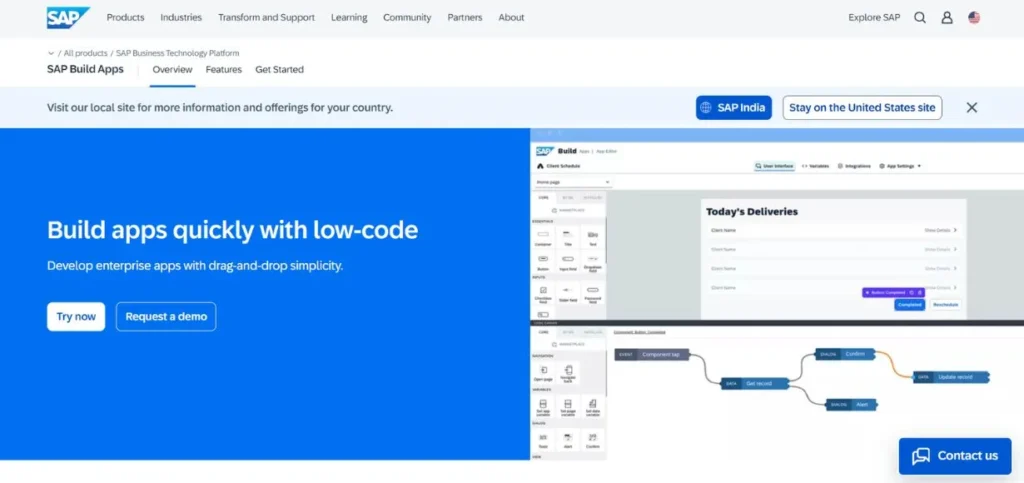
6. SAP Build Apps
Rating: 4.3 / 5
Website: https://www.sap.com/products/technology-platform/low-code-app-builder.html
Best For: Enterprise teams needing SAP-connected apps with strong governance
SAP Build Apps focuses on the use of enterprise teams who are already part of the SAP world. It allows you to drag and drop to web and mobile applications, which are directly connected to S/4HANA and other SAP services – without potentially dangerous custom code. VC Functions Visual Cloud Functions allow you to build serverless backends in a short period of time, and publish iOS and Android apps to the same project. The BTP platform of SAP is baked with security and compliance and has SSO and ISO standards. This tool was created if SAP integration is a necessity.
Key Features
- Native SAP S/4HANA connectors
- Visual Cloud Functions
- iOS & Android deployment
- SSO & ISO compliance
- BTP managed CI/CD
Pros
- Deep SAP integration
- Strong compliance built in
- No custom code needed
Cons
- Tied to the SAP ecosystem
- No source code handoff
- Learning curve for BTP
Pricing: Free
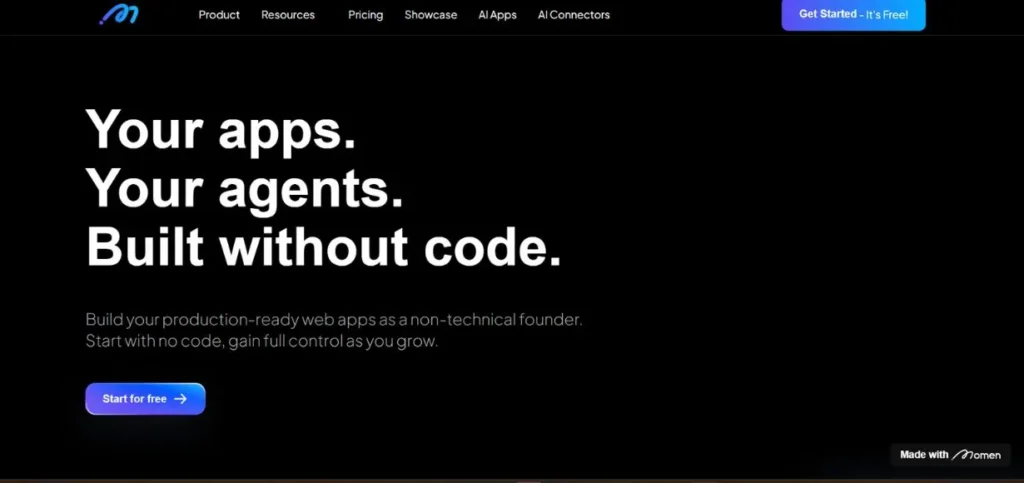
7. Momen
Rating: 4.5 / 5
Website: https://www.momen.app/
Best For: Full-stack web apps with real backend control and AI agents
One of the most complete AI App Builder Platforms on this list is Momen that is a Figma-style canvas with a real backend builder. You create your interfaces, configure your database, create server-side applications with Actionflows, and deploy everything in a single location. It has AI Copilot, which can assist you in schema design and the creation of AI agents in RAG (retrieval-augmented generation). You are even able to bring with you your own AI models. Momen is a highly desirable option in the case of teams that are interested in a full-stack platform with both cloud and on-prem hosting.
Key Features
- Figma-style UI canvas
- AI Copilot & agents
- Built-in database & GraphQL
- AWS BYOC & on-prem hosting
- Row-level security
Pros
- True full-stack control
- Powerful AI features
- Flexible deployment options
Cons
- Web only, no native mobile
- RPS caps on lower plans
- AWS-focused cloud options
Pricing: starts From $33/mo
You can also explore: Identity Theft Protection Apps
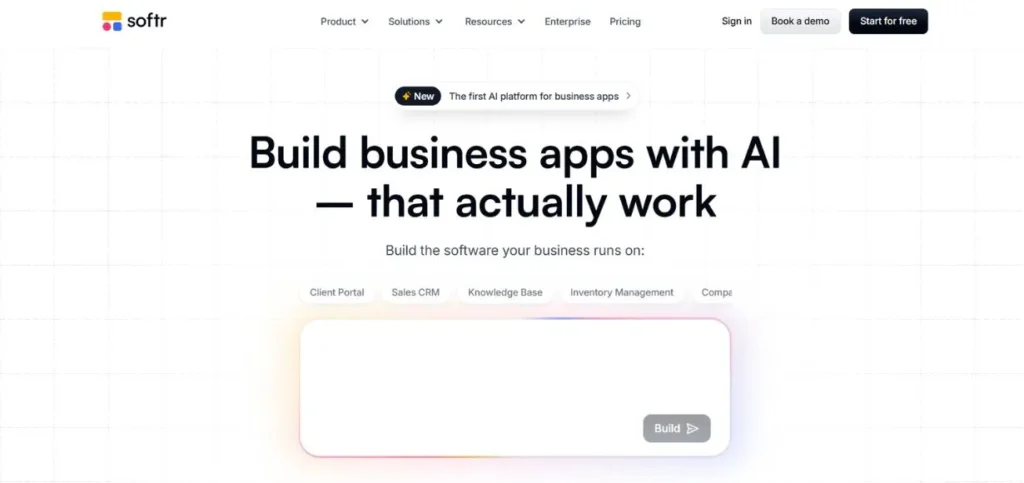
8. Softr
Rating: 4.5 / 5
Website: https://www.softr.io/
Best For: Building client portals and internal tools from existing data sources
Softr is among the simplest methods of transforming your existing data, either in Airtable, Google Sheets or a SQL database, into a refined and secure web application. It is built to suit the teams that require quick results but do not want a complete tech stack. Softr contains chat, data enrichment and automation functions with AI. It also fulfils the requirements of enterprise security like SOC 2 Type II, SSO and elaborate permission controls. It also has custom code extensibility, as well as web hooks. Softr is difficult to beat in terms of speed and ease in case of data-intensive portals.
Key Features
- Airtable, Sheets & SQL connectors
- Built-in AI workflows
- SOC 2 Type II & SSO
- PWA mobile support
- Custom code & webhooks
Pros
- Fastest for portals
- Enterprise security ready
- Easy data connections
Cons
- Hosted only, no export
- PWA, not native apps
- Top features need higher plans
Pricing: Free
9. Bildr
Rating: 4.3 / 5
Website: https://www.bildr.com/
Best For: Design-focused web apps with deep API control and optional self-hosting
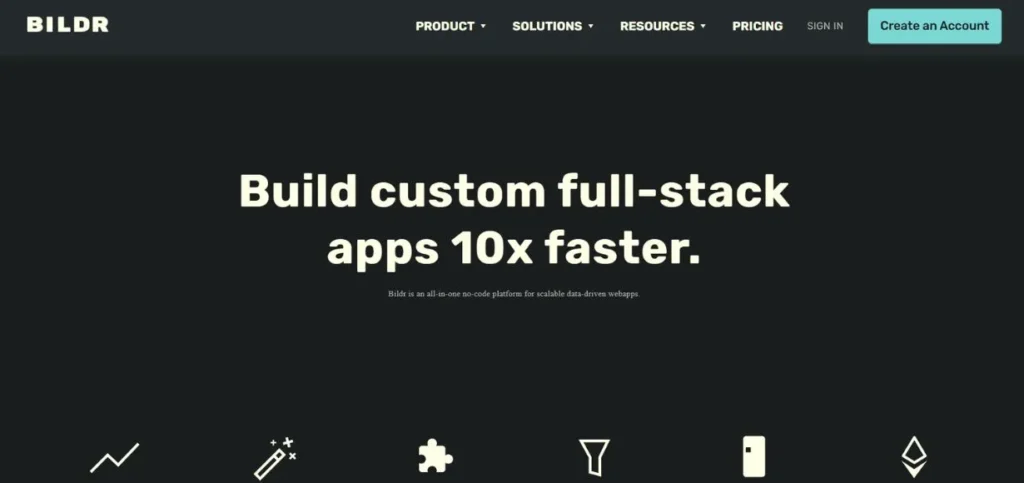
Bildr is designed to give builders the ability to have narrow control of how their web app appears and operates. It has an infinitely canvas-based editor that provides pixel-perfect design freedom, and the system of patterns accelerates frequent flows. It supports adding your own JavaScript and CSS, integrating with any REST API and even creating Chrome extensions or Web3 applications. Bildr is also compatible with partial publishing and unlimited on upper levels. It is also much harder to use than a less complex tool, but the flexibility you receive is also quite impressive, including optional self-hosting.
Key Features
- Infinite canvas editor
- AI-assisted styling
- REST API & Xano support
- Custom JS & CSS
- Self-hosting option
Pros
- Pixel-level design control
- Great API flexibility
- Self-hosting available
Cons
- Steeper learning curve
- Web-only platform
- Smaller template library
Pricing: Free
10. Bravo Studio
Rating: 4.4 / 5
Website: https://www.bravostudio.app/
Best For: Turning Figma designs into published native apps quickly
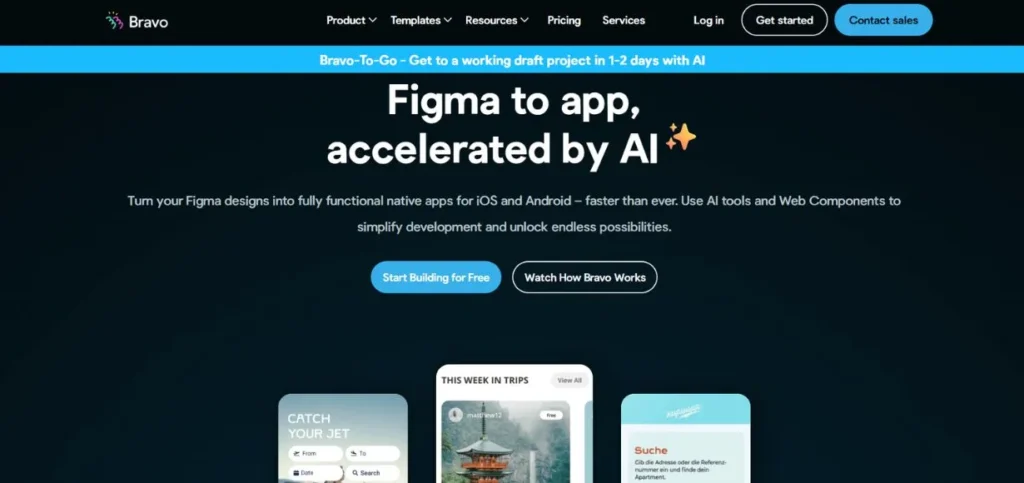
Bravo Studio can offer the design teams the quickest bridge through Figma to an actual native app. All you need to do is add Bravo tags to your Figma layers in order to make them interactive and data-driven. Then connect to your REST API backend Airtable, Xano, Firebase, or any other one and send it to the app stores. Push notifications, in-app purchases, and advertisements are also supported by the popular integration at Bravo. In the case of design-first teams, it eliminates almost all the friction between a refined prototype and an active product.
Key Features
- Figma-native tagging workflow
- REST API backend support
- Push notifications & in-app purchases
- React Native code export (early access)
- OAuth2 & Firebase auth
Pros
- Figma-to-app workflow
- Native app quality output
- Monetization integrations
Cons
- Figma tagging takes learning
- External backend required
- Branding & extras cost extra
Pricing: Free
Explore more: Best Application Control Tools
Step-by-Step: How to Build an App Using AI App Builder Platforms
- Be clear on the idea of your app: Take one sentence and explain the problem your app addresses.
- Select the appropriate platform — Select a builder based on the type of app (requires web, mobile or internal tool)
- Begin with a template – Save hours of installation time with a ready template.
- Connect your source of data – Integrate your database, spreadsheet, or API to retrieve real data.
- Write screens with AI — No-code interface descriptions: Scaffold your interface based on what you want.
- Add logic and workflows — configure button clicks, form fills and automations.
- Check every screen size – Have a preview on mobile phones, tablets and desktops before going live.
- Test user – Before launching, get actual feedback on the site from someone who is not on your team.
- Personalise your URL. Off the shelf with your own domain.
- Publish and make use of — Go online and maintain a surveillance on mistakes, loading times, and interaction.
Common Mistakes to Avoid
- By not doing the planning stage – Bounding into the water without a definite structure of the app is a waste of time in the future.
- Mistakes in the platform selection – Selecting a web-only platform when native apps are required.
- Skipping the aspect of mobile responsiveness – Make your app look broken on phones by just making it desktop-only.
- Running with unreal users – The testing that you are doing now will miss the issues that real users will run into right after use.
- The first one is overbuilding, or trying to add all the features at once: this will delay your launch forever.
- Ability to forget about performance – Too many automations and unoptimized data drag your application down.
- Failure to plan on costs – Usage-based Pricing: surprises. Usage-based Pricing is a common trick; always take a good look at the Pricing page.
- Leap before you can jump out – Select platforms that can be exported, in case ownership is important in the long term.
Conclusion
Creators of AI App Builder Platforms have simplified more than ever, accomplishing the transition between a shaky idea and a real, operating product. They are either a small team, an enterprise innovation group, or a solo founder, but there is a tool on this list that will suit your budget and needs. The only thing you need to do is to choose the one that fits your use case – mobile vs web, simple vs full-stack, hosted vs self-hosted. Small, fast, and continue to get better. Your application does not have to be flawless the first day in the market; it just has to be there.
Frequently Asked Questions (FAQs)
Is it possible to create an application without having to write code?
Yes! Each of the platforms mentioned in this list is intended to be used by individuals who do not have much or any experience with coding. Bubble, Glide and Adalo are drag-and-drop developers with AI tools that can help you create fully operational apps. It does not require any technical expertise, and this is easily achieved with some advanced features.
What is the best AI App Builder Platform for a mobile application?
FlutterFlow and Bravo Studio are the best choice in case you want native iOS and Android apps. FlutterFlow provides Flutter code, and Bravo Studio transforms Figma into published applications. Mobile publishing is also supported by Adalo and Bubble, in case you desire a solution that is complete in one tool.
Is the use of AI App Builder Platforms free?
The majority of the sites on this list provide a free plan as their offer. Free plans are, however, usually limited in terms of features, users or data. Plans on paid are generally priced between $16 to 59 a month. Always ensure that it uses usage-based Pricing: some Pricing models may be action-based, update-based, or row-based.
Is it possible to export my app code from such platforms?
Code export is available on only a few platforms. WeWeb exports Vue.js code, FlutterFlow exports Flutter code, and Bravo Studio exports React Native in early access. Other services, such as Bubble, Adalo, and Softr, do not provide the option of code export, which implies that you will have to rebuild your app in a different environment.
What platform should internal tools or business dashboards be on?
Glide and Softr can be used in internal tools. Glide works well when you store your data in spreadsheets or SQL databases. Softr is compatible with Airtable and Google Sheets. They are both quick to install, provide high levels of security and are popular with operations and business teams as portals and dashboards.