

Businesses are no longer posing questions of whether they need to automate but how quickly. The use of AI workflow automation platforms has brought total change to how teams approach routine tasks, data processing, and cross-platform integrations. Our organizations, whether starting as a startup, or becoming a Fortune 500 company, are realizing the power of artificial intelligence in removing manual bottlenecks, minimizing human error, and realizing massive productivity improvements.
It might be automating emails to your customers, document processing, or a multi-step pipeline orchestration tool, but there is a tool that is specifically designed to meet your requirements. The 10 best AI workflow automation tools of 2026 are discussed in this guide, including broken-down features, pricing, and optimal use cases to enable you to make the smartest decision on behalf of your team.
What is AI Workflow Automation?
The application of artificial intelligence to create, run, and optimize the series of jobs among apps and systems without human supervision is known as AI workflow automation. In contrast to more conventional rule-based automation, AI-based tools are capable of considering context, decision making, data classification and even creating content on demand.
These interfaces can link your favorite applications, initiate action on some intelligent reasoning, and become smarter as they go. In simple terms, AI workflow automation tools are your 24-hour digital employee, which can do all the lead generation to invoice processing and leave your staff to do high value work.
Key Benefits of AI Workflow Automation
- Saves Time and Minimizes Manual Processes: Automates manual processes across applications, liberating teams to think strategically and creatively solve problems.
- Cuts Operational Costs: With large manual operations teams eliminated, large overheads are reduced, and the quality of output will remain the same.
- Enhances Accuracy: AI can remove the human factor of data entry, categorization and processing of documents with uniform and dependable outcomes.
- Scales Easy: Manages large volumes of tasks without any extra manpower and thus expansion becomes easy and economical.
- Deployed AI Agents can make Smarter Decisions: AI agents process data in real-time and take the appropriate action through intelligent and situation-specific reasoning.
- Makes Things Go Faster: Instantly joins hundreds of apps and platforms, dismantling data silos in your whole organization.
Types of AI Workflow Automation Tools
- No-Code Automation Platforms: Drag-and-drop tools such as Zapier and Make available to non-technical users who build cross-app workflows quickly.
- AI Agent Builders: AI Agents A platform that enables developers to make autonomous AI agents, which reason and act on their own, such as n8n and Gumloop.
- Browser-Based Automation: Chrome-extensions such as Bardeen which can automate activities directly in your browser on the fly.
- Enterprise iPaaS Solutions: Workato and Power Automate to orchestrate large-scale, government-intensive business processes.
- Human-in-the-Loop Tools: Human review and AI-driven decisions on sensitive and highly accurate tasks, such as Levity.
- Platforms LLM Pipelines: Predominantly, dedicated platforms such as Vellum AI to deploy, evaluate and monitor AI models of production grade.
10 Best AI Workflow Automation Tools (2026 Guide)
1. Zapier
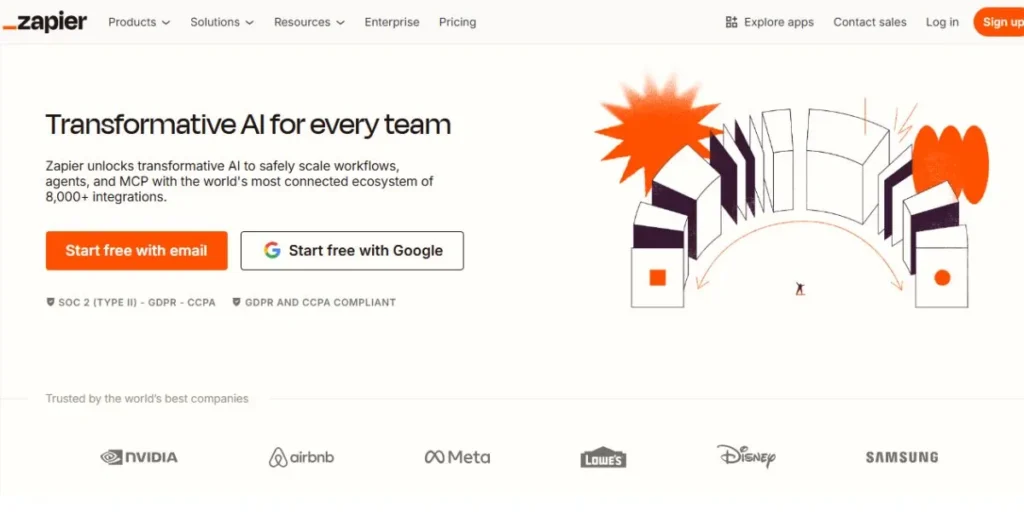
Zapier is the standard in AI workflow automation tools in 2026, with a library of integrations with more than 8,000 apps that would go unmatched. It has now developed much beyond mere simple “Zaps” to a full AI-orchestration system, with Central serving as an autonomous AI agent and Canvas serving as a visual workflow planner. Non technical users are able to directly add natural language AI steps to workflows to summarize, classify or draft content without writing a line of code. It is the preferred option to cross-app task automation at any scale and as fast as possible.
Key Features:
- 8,000+ app integrations
- AI-powered Zap builder
- Autonomous AI agents (Central)
- Multi-step conditional logic
- Visual Canvas workflow mapper
- Natural language troubleshooting
Best For: Quick no-code cross-app automations
Pricing: Free plan available; Pro from $19.99/mo
Website:https://zapier.com
2. Make (formerly Integromat)
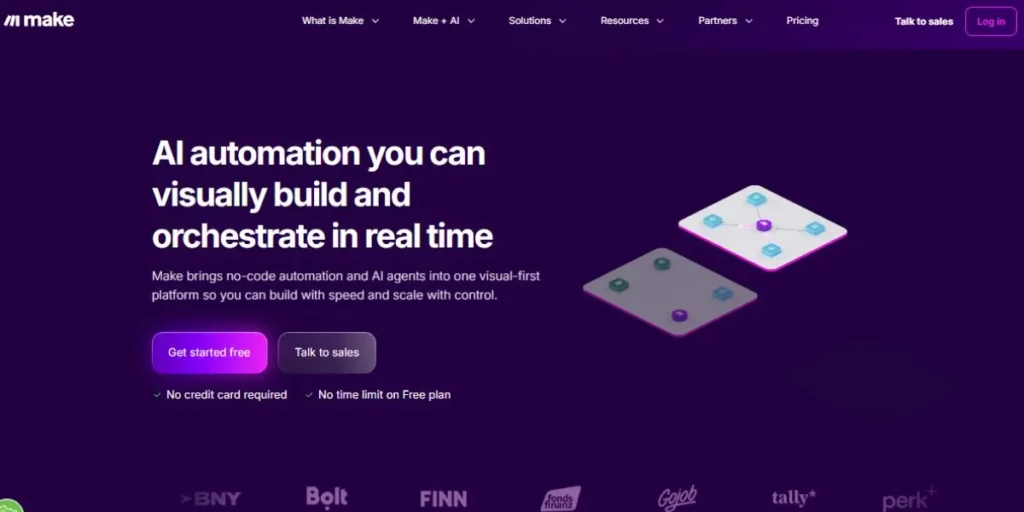
Make is an extremely powerful visual automation platform, which provides operations teams with granular control of complex workflows. It has a canvas-based interface with multi-branch logic, iterators and advanced data transformations. Make, in 2026, has fully intelligent AI agents which can reason and think as components of a scenario, rather than as discrete steps. Being one of the most affordable AI workflow automation tools of operations with high process volumes, it is an intelligent Zapier substitute for teams with considerable volume of data.
Key Features:
- Visual multi-branch logic builder
- Granular data transformation
- Native AI agent integration
- Real-time execution visualization
- 3,000+ pre-built connectors
- Advanced error handling
Best For: Complex high-volume visual workflows
Pricing: Free plan available; Core from $10.59/mo
Website:https://make.com
3. n8n
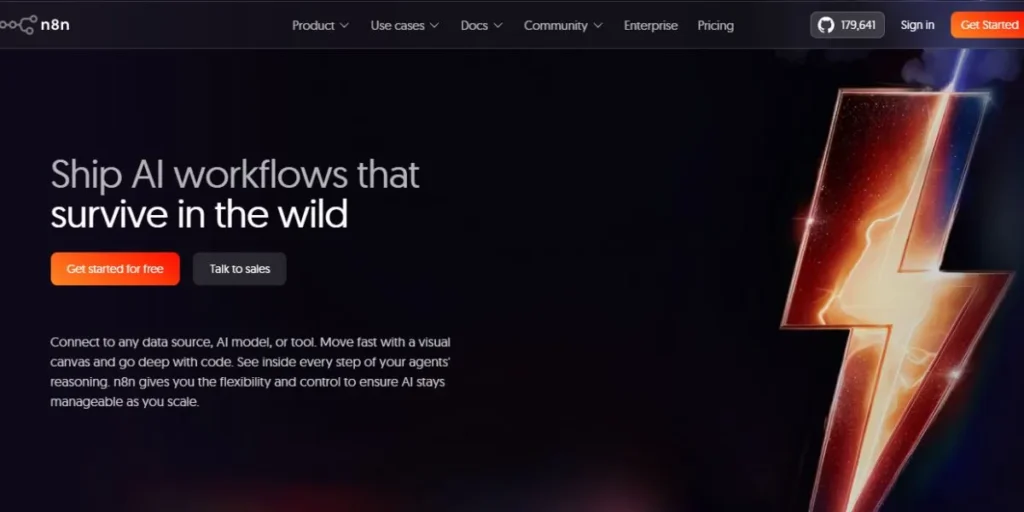
n8n is the most popular open-source, low-code automation platform – and one of the most comprehensive AI workflow automation tools platforms currently. Designed to both be self-hosted or through the cloud, it is designed to be used by technical teams that need complete control over their data. It has a node-based editor, written in JavaScript and Python steps, and has advanced LangChain nodes to create complex AI agents and RAG (Retrieval-Augmented Generation) pipelines. It is scalable for developer-led teams as it does not require per-task billing and is licensed under a fair-code license.
Key Features:
- Self-hosting for full data compliance
- Native LangChain & AI nodes
- Custom JavaScript/Python coding tools
- Node-based visual builder
- Source-available architecture
- Advanced RAG pipeline support
Best For: Self-hosted technical team automation
Pricing: Free (self-hosted); Cloud from $20/mo
Website:https://n8n.io
4. Gumloop
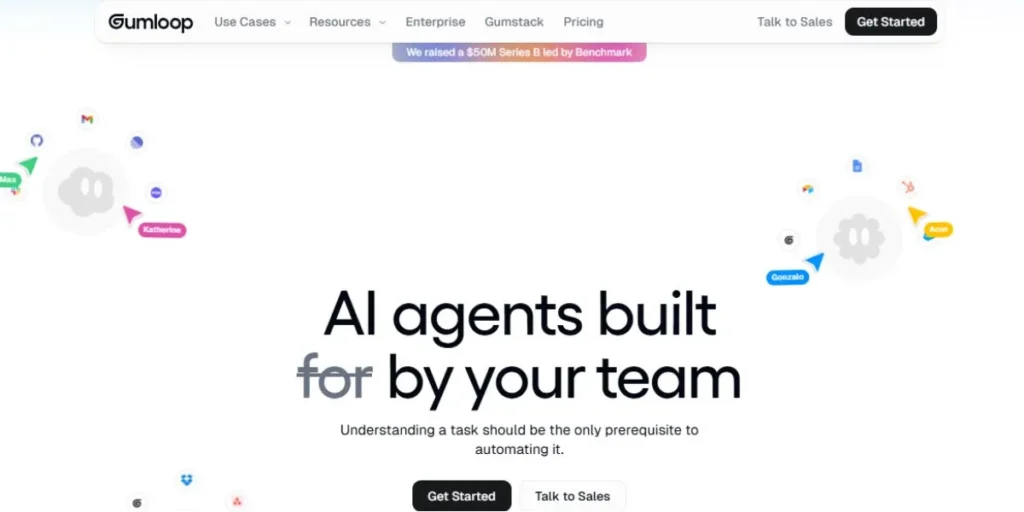
Gumloop is a purpose-built automation platform built on AI that is designed to perform complex AI tasks, such as web scraping, document processing, and agentic workflows. One of the most significant distinctions that make it stand out of other AI workflow automation tools platforms is that its subscription will provide access to high-end LLMs such as GPT-4 – which means there are no additional API keys required. Its Gummie AI assistant can construct complete workflows based on simple natural language instructions, and is unbelievably friendly to individual creators and agencies that are interested in AI-first automation.
Key Features:
- Built-in premium LLM access (GPT-4)
- AI-native web scraper and parser
- Gummie AI workflow builder
- Model Context Protocol (MCP) support
- Visual drag-and-drop canvas
- Community-driven template library
Best For: AI-heavy agents and scraping tasks
Pricing: Free plan available; Solo from $30/mo
Website:https://gumloop.com
5. Bardeen
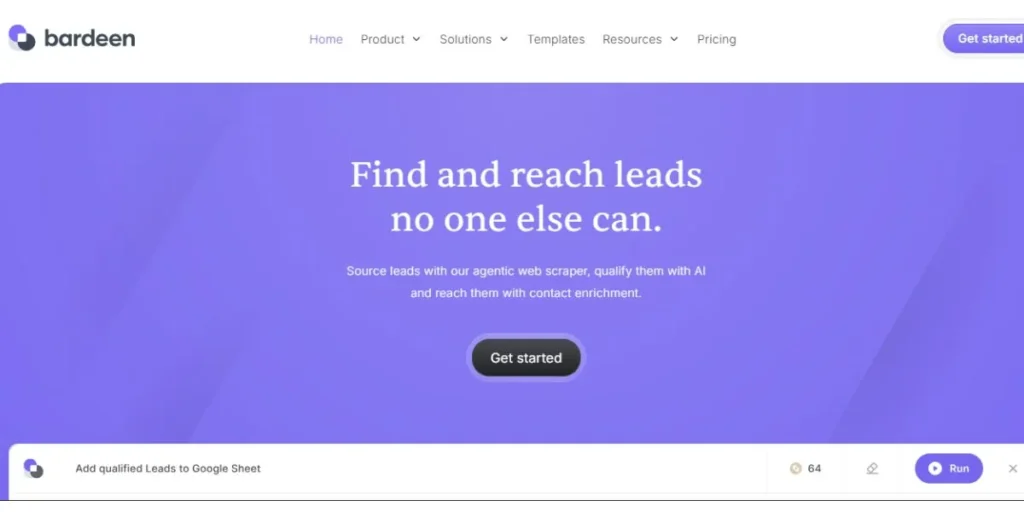
Bardeen is a special browser automation app, which functions as a Chrome extension, automating things precisely where you already spend time on the internet. It is one of the AI workflow automation tools that are distinguished by its natural language search based automation under the Magic Box, strong web scraping, and lead enrichment features. In 2026, it operates autonomous agents to process GTM motions, both through finding leads on LinkedIn to one writing personalized outreach emails, and it is invaluable to sales, recruiting, and research professionals.
Key Features:
- Chrome extension-based automation
- AI-powered web scraping
- Natural language “Magic Box” builder
- 100+ app integrations
- Local data processing
- Pre-built automation “Playbooks”
Best For: Browser-based sales and research tasks
Pricing: Free plan available; Pro from $10/mo
Website:https://bardeen.ai
6. Airtable
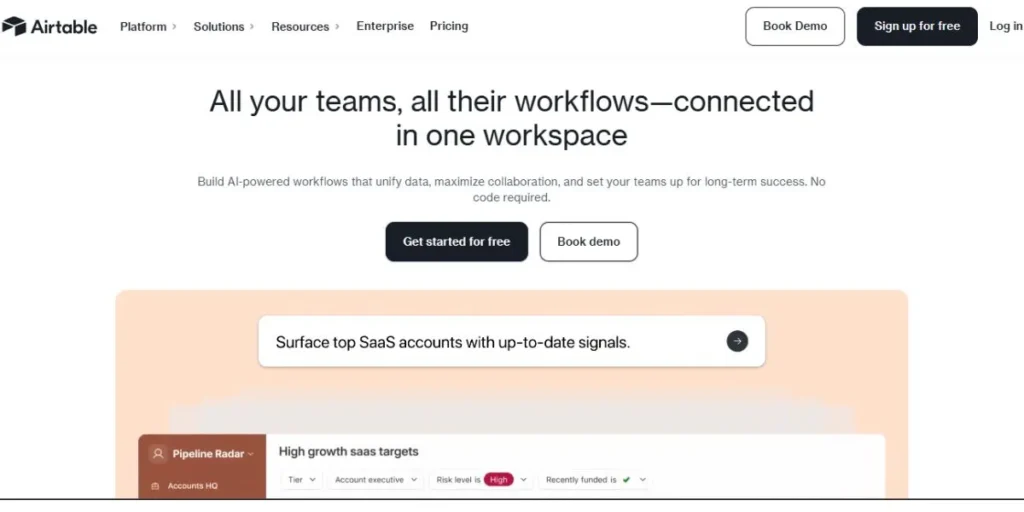
By 2026, Airtable has become one of the strongest AI workflow automation systems available in the market since it is no longer a simple database, but an incredibly strong system. It has a native Airtable AI that enables users to summarize records, create content, and categorize data directly in the workspace. Its AI Agents are constantly running in the background, coordinating multifaceted activities within marketing and product operations teams. It is excellent when a team desires their data, automations, and AI decision-making to co-exist in a single home.
Key Features:
- Native AI record enrichment
- Background-running AI agents
- 1,000+ native app integrations
- No-code visual automation builder
- Kanban, Gantt, and Grid views
- Enterprise-grade audit logs
Best For: Unified data-driven team workflows
Pricing: Free plan available; Paid from $20/mo
Website:https://airtable.com
7. Vellum AI
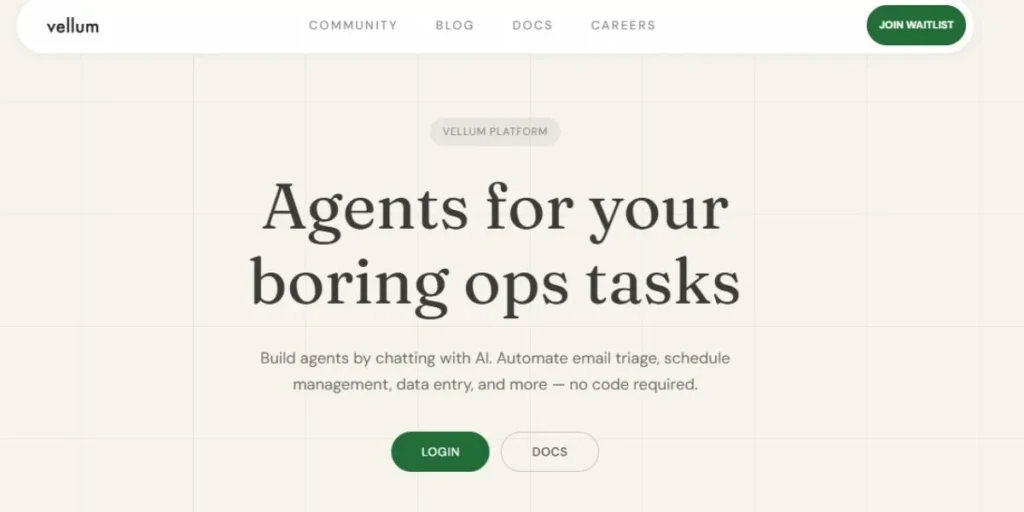
Vellum AI is a platform that is designed specifically to run production-ready AI agents and LLM pipelines and is therefore among the most specific tools of AI workflow automation. In contrast to general-purpose automation tools, it takes the lifecycle of AI features as a whole, including prompt engineering and side-by-side comparisons, as well as deployment and real-time monitoring. It is the ideal solution between users of non-technical business and those engineers who can harden pipelines through SDKs and thus is indispensable in teams where AIs form the essential part of the product.
Key Features:
- Native prompt evaluation & comparison
- Version control for LLM prompts
- End-to-end trace observability
- TypeScript/Python SDK support
- Semantic routing primitives
- VPC and on-premise deployment
Best For: Production AI pipelines and evaluation
Pricing: Free tier available; Paid from $25/mo
Website:https://vellum.ai
8. Workato
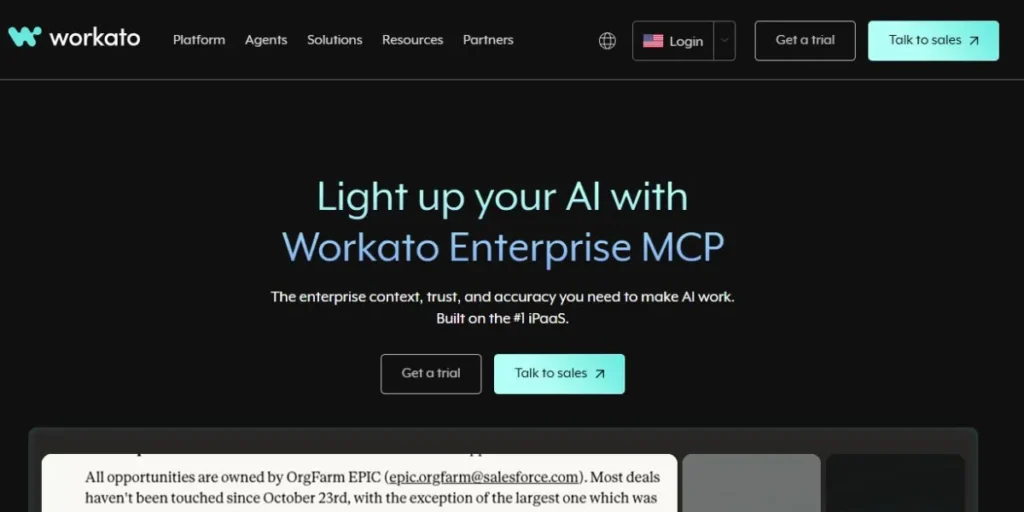
Workato is a service based on an enterprise Integration Platform in cloud computing (iPaaS), as well as one of the strongest AI workflow automation platforms in large corporations. It manages multifaceted security, governance and compliance demands such as SOC 2 and SAML SSO. By 2026, it focuses on the concept of Agentic Orchestration with the AIRO co-pilot and Genie agent library. It is the platform of choice by IT and HR departments of big companies that require high-reliability and mission-critical automation with 1,200+ enterprise connectors and hybrid cloud/on-premise agents.
Key Features:
- Enterprise governance and RBAC
- AIRO AI workflow co-pilot
- 1,200+ enterprise-grade connectors
- Hybrid cloud and on-premise agents
- Intelligent document processing
- Guaranteed uptime SLAs
Best For: Large enterprise process orchestration
Pricing: Custom enterprise pricing only
Website:https://workato.com
9. Microsoft Power Automate
Microsoft Power Automate serves as the logical selection within the framework of organizations integrated into the ecosystem of Microsoft 365, and one of the most actively used AI-based workflow automation tools on the enterprise landscape. It is based on Microsoft Copilot that enables users to create workflows with natural language prompts. This is the seamless integration of Cloud Flows (DPA) with Desktop Flows (RPA) in 2026, which allows AI to interact even with older software that does not have any modern APIs — ideal to automate approvals, document processing, and data movement between Teams, Excel, and Outlook.
Key Features:
- Deep Microsoft 365 integration
- Copilot natural language builder
- Cloud and Desktop RPA flows
- AI Builder with OCR capabilities
- Standardized governance controls
- 400+ third-party app connectors
Best For: Microsoft-centric ecosystem automation
Pricing: From $15/user/month
Website:https://powerautomate.microsoft.com
10. Levity
Levity is a human-in-the-loop platform and one of the most approachable AI workflow automation tools to small and medium businesses. It is dedicated to categorizing images, text, and documents without need of any data science skills. Its AI processes are set to identify so-called low-confidence decisions, which are reviewed by humans and establish almost 100 percent accuracy in sensitive processes. As of 2026, it is still the best choice among the SMEs wishing to automate tiresome and repetitive functions without having to lose a human quality check in the loop.
Key Features:
- Human-in-the-loop validation steps
- No-code AI model training
- Text, image, and document classification
- 500+ app integrations
- Built-in OCR capabilities
- Predictive workflow suggestions
Best For: SME document and task AI automation
Pricing: Paid plans from $99/mo
Website:https://levity.ai
AI Workflow Automation Platforms Comparison
| Tool Name | Best For | Pricing | Complexity |
| Zapier | Quick no-code automations | Free; Pro from $19.99/mo | Low |
| Make | Complex visual workflows | Free; Core from $10.59/mo | Medium |
| n8n | Self-hosted technical teams | Free; Cloud $20/mo | High |
| Gumloop | AI-heavy agents & scraping | Free; Solo from $30/mo | Medium |
| Bardeen | Browser-based sales tasks | Free; Pro from $10/mo | Low |
| Airtable | Unified team data workflows | Free; Paid from $20/mo | Low–Medium |
| Vellum AI | Production LLM pipelines | Free; Paid from $25/mo | High |
| Workato | Enterprise orchestration | Custom pricing | Very High |
| Power Automate | Microsoft 365 ecosystems | From $15/user/mo | Medium |
| Levity | SME document classification | From $99/mo | Low |
How to Choose the Best AI workflow automation tools
- Define Your Use Case First: Are you automating simple tasks, or using AI agents, document processing, or enterprise-scale orchestration, before comparing products?
- Evaluate Level of Technical Skill: Non-code tools, such as Zapier, are oriented at non-technical teams; tools that are more engineering-oriented, such as n8n, are oriented at engineering-rich environments.
- Check Integration Compatibility: Make sure that the platform is integrated with your existing stack – CRM, email, ERP, databases, and cloud storage.
- Compare Pricing vs. Volume: There are tools that charge by the task and those that charge by the seat. With large workflow volumes, flat-rate tools such as n8n offer greater value over the long run.
- Take Data Compliance Requirements into Account: If your area requires data sovereignty, focus on self-hosted or VPC-deployable applications such as n8n or Vellum AI.
- Begin with a Free Trial: The majority of the platforms have free tiers or free trials. The most fruitful results are possible in testing your base workflow before investing in a paid plan.
Pros & Cons of AI workflow automation tools
Pros
- 24/7 Continuous Operations: There is no need for fatigue or breaks, or even human supervision of AI workflows.
- Enormous Productivity Increase: Teams will be able to refocus the time they wasted in manual activities to other more productive strategic activities.
- Uniform Quality of output: There is no variability due to human error and instead, there are standardized results whenever output is produced.
- Quick Implementation: The current no-code systems enable applications to realize a vision of a live automation within hours of development instead of weeks.
- Scalable at No Extra Cost: After being created, automations can deal with 10x or 100x volume without correspondingly rising costs.
- More Data Insights: Workflows that are automated can be captured and recorded in the form of rich data trails to be analyzed and optimized.
Cons
- Initial complexity of set up: This can take a lot of time and expertise to set up some tools properly, particularly in more advanced applications.
- Limitations on Integration: Not all apps or legacy systems are available to connect to; in some cases, it may be necessary to do custom API development or a workaround.
- Over-Reliance Risk: Teams can become over-reliant on automation, making them susceptible to workflow or service failures.
- Hallucinations with AI: AI models are sometimes prone to producing incorrect results, particularly when there is no appropriate prompt tuning or validation.
- Cost Creep at Scale: The per-task pricing model may lead to unexpected bills as automation volume grows rapidly.
- Maintenance Overhead: Workflows should be updated regularly as the matching apps change their APIs, layouts, or data structures.
Conclusion
The future of AI workflow automation tools in 2026 is richer, smarter, and more accessible than ever before. The automation of the lead generation process using Bardeen, the creation of RAG pipelines in n8n or the implementation of mission-critical processes in Workato – there is a solution tailored to almost every need.
The trick is to find the tool that fits your technical strengths, the complexity of your workflow, and your company’s standards. Test, scale, start small, and test thoroughly. The appropriate AI workflow automation tool is not just time-saving; it is a game-changer for how your company runs its business.
Visit for More Information:
FAQs
What is AI workflow automation?
AI workflow automation is a platform that automates tasks involving multiple steps across apps and systems using artificial intelligence, minimizing manual work and enhancing efficiency.
What is the easiest AI workflow automation platform?
The easiest-to-use homeworkify alternatives are Zapier and Bardeen, both of which offer no-code interfaces and natural language builders, and neither requires a technical background to get started.
Is it possible to replace human workers with AI workflow automation tools?
No – they are meant to be carrying repetitive and rule-based workloads so that humans can engage in creative and strategic work. Sensitive decisions are even maintained in a platform such as Levity where human beings are kept in the loop.
Does it have free AI workflow automation software?
Yes. Zapier, Make, n8n, Gumloop, Bardeen and Airtable have free plans or tiers with limited functionalities, and it is easy to start with them without any initial cost.
What does Zapier and n8n have in common?
Zapier is a cloud-only, no-code platform suitable for users who are non-technical and need simple automation. n8n is a self-hostable, open-source tool that is suited when technical staff need to retain control and own their own code and data.