

In today’s hyper-connected digital economy, businesses depend on dozens, in some cases hundreds, of third-party vendors, suppliers, and service providers. All of these relationships imply the possibility of risk: information security breaches, compliance issues, business interruptions, and image damage. These risks cannot be manually handled anymore.
It is at this point that a vendor risk management tool would be essential. These systems robotise all the stages of the third-party risk lifecycle, including onboarding and assessment, as well as ongoing monitoring and remediation. By 2026, selecting one of the appropriate vendor risk management platforms may be a matter of life and death to an otherwise well-established, resilient organization or an expensive, high-profile breach.
What Is a Vendor Risk Management Platform?
A vendor risk management platform is a special software developed to assist companies in the identification, evaluation, management, and control of risks relating to their third-party vendors and suppliers.
Instead of using hardcopy spread sheets and manual email, these platforms automate security questionnaires, continuous oversight, compliance tracking, and remediation procedures. They provide central visibility to security, compliance and procurement teams of their entire vendor ecosystem – which allows risk decisions to be made faster, smarter and more consistently across the organization.
Why Modern Organizations Need a VRM Platform
- Scaling vendor ecosystems: establish unknowns that can never be addressed manually.
- Regulatory pressure: under regulatory mandates such as GDPR, CCPA, and HIPAA require documented and repeatable vendor due diligence.
- Third-party breaches: are not the most frequent, but one of the primary causes of data loss in enterprises, and it is necessary to monitor it proactively.
- Supply chain attacks have increased significantly, and organizations need to extend their suggestions beyond direct vendors to lower-tier suppliers.
- Cyber insurance requirements: are becoming more and more formal vendor risk programs as a prerequisite to coverage.
- Board-level accountability: should imply that executives have quantifiable risk metrics, rather than anecdotal evaluations.
Vendor Risk Management Framework
An effective vendor risk management policy gives a systematic, repeatable procedure for overseeing third-party risk throughout the entire vendor lifecycle. It usually comprises of five steps: vendor identification and classification, initial due diligence and initial onboarding assessments, ongoing monitoring during the relationship, incident response and remediation in case of problems, and formal offboarding and data destruction verification.
A good model also complies with the industry standards like the NIST, ISO 27001, and SOC 2 so that your program is not only justified to the auditors but significant to your security team in practice.
Key Features to Look for in a VRM Platform
- Automated security questionnaires: save man-hours and accelerate the vendor onboarding and evaluation process dramatically.
- External monitoring: monitors a vendor’s current attack surface in real-time, flagging emerging vulnerabilities without requiring periodic review.
- Risk scoring and rating: develop objective, quantifiable scores so teams can prioritize the most risky vendor relationships first.
- Compliance and regulatory mapping are used to ensure the alignment of vendor assessment with applicable frameworks such as SOC 2, ISO 27001, GDPR, and HIPAA.
- Automation of workflows and integrations: connect with the current GRC, procurement, and ticketing applications to remove data silos.
- Executive reporting dashboards: through the use of complex risk data, convert this data into comprehensible and board-friendly information that assists in strategic decision-making.
Top Vendor Risk Management Platforms (2026) — At a Glance
| # | Platform | Best For | Top Feature |
| 1 | UpGuard | Mid-to-large enterprises | AI-powered attack surface monitoring |
| 2 | Bitsight | Data-driven risk management | 0–820 cybersecurity ratings |
| 3 | SecurityScorecard | Threat intelligence | A-F vendor security grades |
| 4 | OneTrust | Privacy & compliance | Regulatory automation (GDPR, CCPA) |
| 5 | Prevalent | Multi-domain risk monitoring | 500K+ source intelligence network |
| 6 | ProcessUnity (CyberGRX) | Efficient due diligence | Predictive risk AI + shared assessments |
| 7 | Panorays | Customized vendor monitoring | Relationship-based Risk DNA scoring |
| 8 | Venminder | Resource-constrained teams | Expert-led managed assessments |
| 9 | RiskRecon (by Mastercard) | External security visibility | 11-domain cybersecurity health scoring |
| 10 | Aravo | Global supply chains | N-tier supply chain visibility |
Top 10 Vendor Risk Management Platforms (2026) — Detailed Reviews
1. UpGuard
UpGuard is a single vendor risk management service that automates the entire process of third-party risk. It is an amalgamation of AI-led security questionnaires and real-time attack surface monitoring, allowing security teams with a 360-degree perspective of their vendor ecosystem.
UpGuard empowers organizations to identify, evaluate, and address vendor risks at scale, through intelligent automation, replacing manual spreadsheets to support mid-to-large enterprise security teams to achieve measurable, compliance-ready outcomes.
Key Features:
- AI-powered security questionnaires
- Real-time attack surface monitoring
- Automated risk remediation workflows
- Executive-level security reporting
Pricing: Starting at $1,599/month
Best For: Mid-to-large enterprise security teams
Website: https://www.upguard.com/
2. Bitsight
Bitsight is a vendor risk management data platform that is data-driven and it pioneered the idea of cybersecurity ratings. It provides objective and up-to-date security scores on a 0 to 820 numerical scale, such as a financial credit score, on thousands of vendors.
Deep threat intelligence, malware scanning, and quantifying financial risks enable organizations to rank vendor relationships according to the actual potential breach impact, so that Bitsight is a reliable option to risk-driven, metrics-based security programs across the globe.
Key Features:
- Objective 0–820 security ratings
- Cyber risk financial quantification
- Continuous automated monitoring
- Malware and botnet threat intelligence
Pricing: Custom quote on request
Best For: Data-driven, risk-based vendor management
Website: https://www.bitsight.com/
3. SecurityScorecard
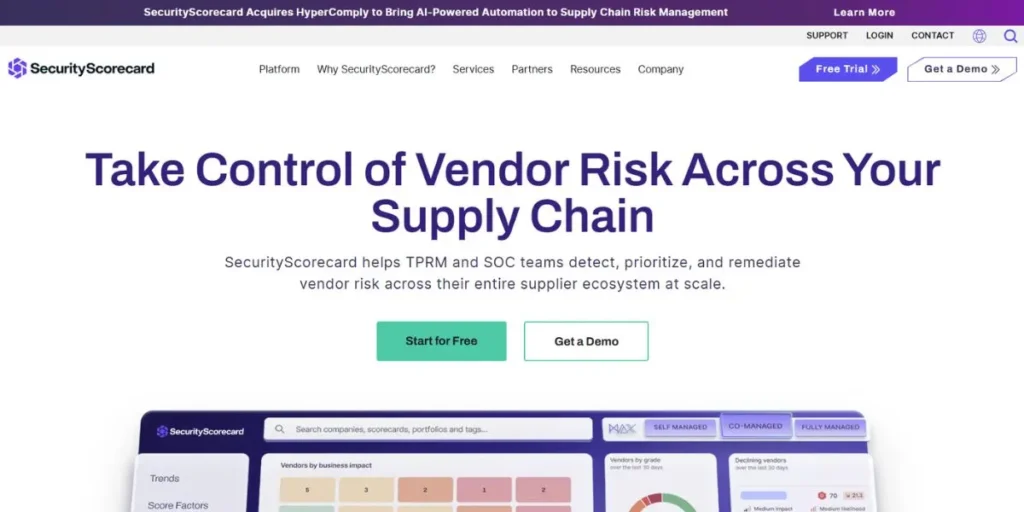
SecurityScorecard is an effective vendor risk management tool that streamlines the process of third-party risk by providing easy A-F letter grades that are security-related. It keeps scanning millions of businesses on vulnerabilities, stolen credentials, and improper configurations throughout their online presence.
The Atlas module enables a smooth transfer of questionnaires and evidence between the organization and its vendors. SecurityScorecard is the right solution in the case of technology-intensive companies that need encompassing, real-time data on threats and have large vendor bases requiring efficient dark web monitoring and automated remediation estimations.
Key Features:
- A-F vendor security letter grades
- Dark web threat monitoring
- Collaborative Atlas evidence exchange
- Automated remediation impact projections
Pricing: Custom quote on request
Best For: Tech-forward enterprises prioritizing threat intelligence
Website: https://securityscorecard.com/
4. OneTrust
OneTrust is a vendor risk management solution that is compliance-driven and specifically designed to support organizations that operate in complex global privacy regulations. It is perfect in automating privacy impact assessment, data flow mapping vendors and aligning programs to GDPR, CCPA and HIPAA standards.
In 2026, its strong AI connection speeds up the evidence gathering and regulatory mapping, which simplifies and enhances the workflow and consistency of compliance processes. The best possible option is OneTrust when it comes to legal, privacy, and compliance teams with a significant amount of regulatory vendor requirements.
Key Features:
- Regulatory compliance automation
- Data discovery and flow mapping
- Scalable questionnaire templates
- Integrated GRC workflow automation
Pricing: Median $11,500/year platform fee
Best For: Privacy and regulatory compliance programs
Website: https://www.onetrust.com/
5. Prevalent
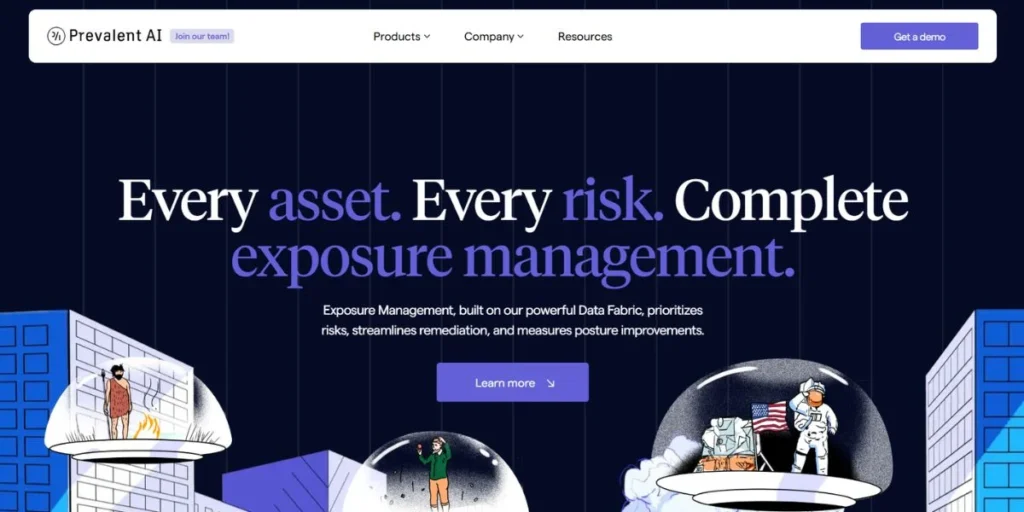
Common is an all-encompassing vendor risk management platform of cyber, financial, operational, and reputational risks under a single solution. Its Global Vendor Intelligence Network tracks more than 500,000 sources – such as the dark web and financial databases – of vendor threats.
Prevalent is the only cloud that is uniquely flexible, having a hybrid cloud and on-premise deployment option with optional managed assessment services. It is applicable to those organizations seeking professional assistance alongside automated solutions of a multi-domain vendor risk program that is scalable.
Key Features:
- 500K+ source global intelligence network
- Managed risk assessment services
- Hybrid cloud and on-premise deployment
- AI-driven remediation guidance
Pricing: Custom quote on request
Best For: Flexible, multi-domain risk monitoring programs
Website: https://prevalent.ai/
6. ProcessUnity (CyberGRX)
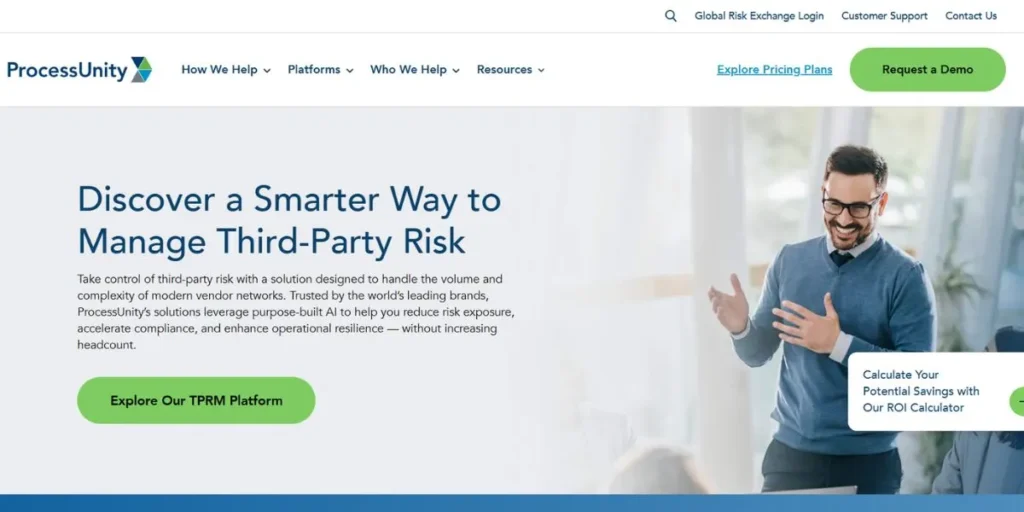
ProcessUnity is an efficiency-based vendor risk management platform, free of duplication of due diligence by sharing a vendor evaluation with others. Organizations also can access pre-shaped tests of thousands of different vendors, reducing the wait times of response to a thin slice.
Its most impressive feature is its popular Predictive Risk Insights, which uses machine learning to detect potential vendor vulnerabilities before the assessment even takes place. ProcessUnity is a secure management solution that suits the requirements of the security team that is more focused on speed, scalability, and intelligent automation in third-party risk processes.
Key Features:
- Predictive risk assessment AI
- Shared vendor assessment exchange
- Streamlined due diligence workflows
- Configurable executive risk dashboards
Pricing: Custom quote on request
Best For: Organizations prioritizing highly efficient due diligence
Website: https://www.processunity.com/
7. Panorays
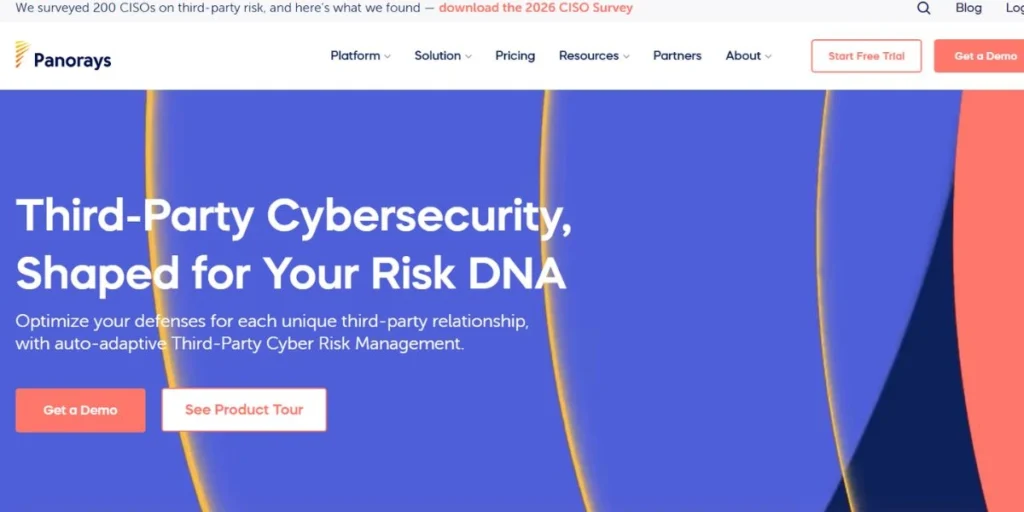
Panorays is a relationship-based vendor risk management software that personalizes every evaluation based on its proprietary “Risk DNA” technology. Instead of discovering all types of risk through the use of the one-size-fits-all methodology, it tailors risk scoring according to the unique characteristics of each vendor relationship and a level of data access.
AI automatically scans available certifications of vendors, such as SOC 2, and pre-populate questionnaires to dramatically reduce administrative workload. Panorays is recommended in the cases when an organization is in need of accurate and contextual vendor tracking supported by dynamic external attack surface analysis.
Key Features:
- Relationship-based Risk DNA scoring
- AI-accelerated questionnaire completion
- Dynamic external attack surface analysis
- Native GRC system integrations
Pricing: Custom quote on request
Best For: In-depth, relationship-customized vendor monitoring
Website: https://panorays.com/
8. Venminder
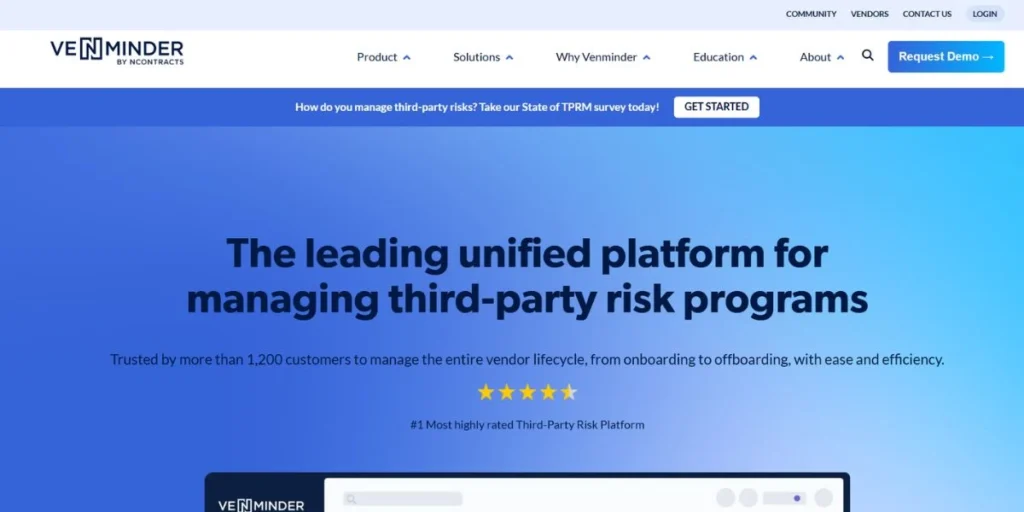
Venminder is an online vendor risk management service with a unique combination of SaaS technology and direct, expert evaluation services. Its software plus services approach enables resource limited teams to subcontract vendor assessments to qualified specialists providing more than 30,000 expert-guided evaluations per year.
The financial health tracking, contract management, and cybersecurity modules are specialized to cover the entire range. Venminder can be the best option to the compliance and risk teams who require professional-grade vendor assessments without the additional cost of developing a sizable inside team.
Key Features:
- Outsourced expert assessment services
- Automated vendor onboarding workflows
- Centralized compliance document storage
- Financial health tracking modules
Pricing: Custom quote on request
Best For: Resource-constrained vendor risk teams
Website: https://www.venminder.com/
9. RiskRecon (by Mastercard)
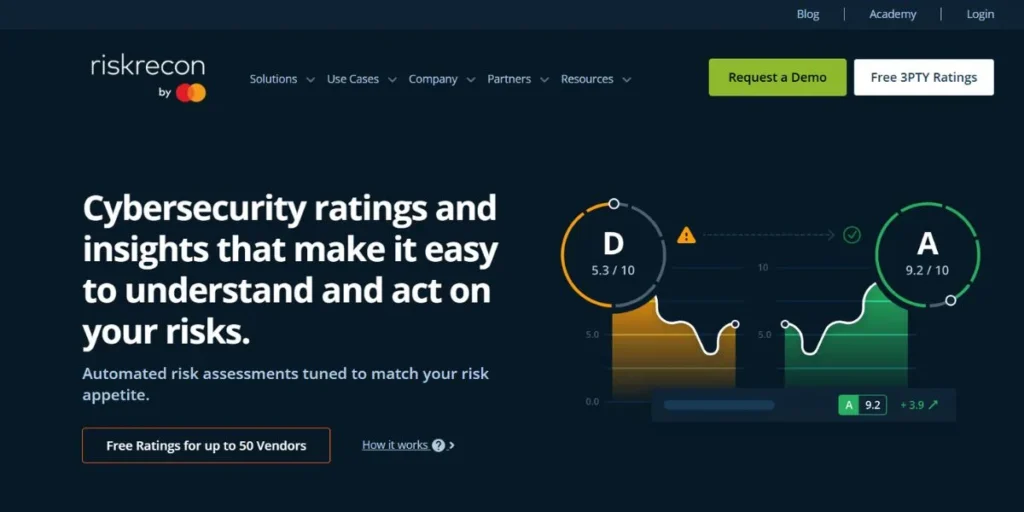
RiskRecon is a professional vendor risk management tool, owned by Mastercard, intended to provide comprehensive, objective information on the health of cybersecurity to third-party partners and suppliers. It determines the vendor risk in 11 separate security areas by examining the digital assets that are publicly available, and presents evidence-based, quantified risk scores.
Although it does not come with questionnaire workflows built in, RiskRecon is a popular high-fidelity monitoring layer used as an added component of larger GRC systems, and is thus essential to companies that need external security visibility in a granular and continuous form.
Key Features:
- 11-domain cybersecurity health scoring
- Real-time vulnerability monitoring
- Evidence-based risk quantification
- Detailed vendor asset inventory discovery
Pricing: Custom quote on request
Best For: Deep external security visibility and monitoring
Website: https://www.riskrecon.com/
10. Aravo
Aravo is a vendor risk management platform designed as an enterprise platform, to cater to large global organizations managing a complex and high-volume ecosystem of third parties. Its exceptionally flexible workflows can be configured to any domain of risk, such as cybersecurity and financial health, ESG and anti-bribery compliance.
The highly valued capability of Aravo in the year 2026 is the n-tier visibility in supply chains, which will allow organizations to monitor the vendors, as well as the vendors of their vendors. It is the ultimate platform of multinational corporations that require global supply chain risk management that is fully global and highly customizable.
Key Features:
- High-scale enterprise configurability
- Multi-tier (n-tier) supply chain visibility
- Integrated ESG risk tracking
- Complex global workflow automation
Pricing: Custom quote on request
Best For: Large-scale global supply chain management
Free & Low-Cost Vendor Risk Management Tools
| Tool | Best For | Key Feature | Cost |
| FAIR (Open Group) | Risk quantification frameworks | Financial risk modeling methodology | Free |
| VSAQ (Google) | Small teams, basic questionnaires | Open-source vendor security questionnaire | Free |
| CIS Controls Self-Assessment | SMBs starting their VRM journey | Baseline security benchmark mapping | Free |
| NIST SP 800-161 Toolkit | Government & public sector | Supply chain risk management templates | Free |
| LogicGate (Starter) | Growing compliance teams | Configurable GRC workflows | Low-cost |
| Whistic (Free Tier) | Startups and small businesses | Self-service vendor security profiles | Free/Freemium |
How to Choose the Best Vendor Risk Management Platform
- Identify your risk areas: identify what type of risk you need to cover: cyber, financial, ESG, or operational risk.
- Test your in-house capabilities: in case your team is small, consider platforms that have managed services or artificial intelligence-based assessments, such as Venminder or UpGuard.
- Check integration compatibility: integration with your existing GRC, procurement and ticketing systems to prevent the creation of new data silos.
- Assess coverage of vendors: certain vendors such as SecurityScorecard keep a track of millions of businesses, which is crucial when it comes to big vendor bases.
- Think about scalability: Aravo manages thousands of vendors across the world, whereas less intensive tools cover smaller programs with less complex needs.
- Request a proof of concept (POC): using your own data of vendors prior to committing, make sure that the scoring and workflows meet your requirements in the real world.
Vendor Risk Assessment Best Practices
- Prioritize your vendors: not all vendors require the same level of assessment; first direct your resources at high-impact third parties.
- Have standardized questionnaires: such as SIG (Standardized Information Gathering) so that all vendors are measured in a similar manner with comparable data.
- Conduct constant monitoring: instead of annual point-in-time inspections, the security posture of a vendor can become compromised within a very short period of time between cycles.
- Add contract terms: that will make the vendors inform you of breaches, audit, or material changes to their security environment.
- Evaluate third-party risk: inquiring key vendors about their relationship with their supplier to find out which sub-tiers in your supply chain are hidden.
- Record all of this: keep proper records of evaluations, conclusions, and corrective measures in order to prove due diligence to auditors and regulators.
Conclusion
One of the threats vectors that are growing rapidly in modern organizations is vendor risk. With supply chains becoming more complex and regulatory laws tightening around the world, it is no longer considered a choice to deploy a strong vendor risk management platform; it is now a must-have business.
Regardless of being a Fortune 500 company with thousands of suppliers around the globe or a rising mid-market company in the process of establishing your VRM program, 2026 is more capable, AI-powered and cost effective than ever. Just follow this guide and select an appropriate platform to fit the size of your organization, its risk appetite and compliance needs and feel confident that you have a firm grip on your third party risk.
FAQs
What is the point of a vendor risk management platform?
A vendor risk management system streamlines the third-party vendor process of identifying, assessing, monitoring, and mitigating risk to third-party vendors, replacing manual spreadsheets with scalable, ongoing risk intelligence.
What is the average cost of a vendor risk management tools?
Prices are all over the board- free open-source software and enterprise software can be as cheap as $1,599/month (such as UpGuard), or even more expensive due to tailored applications of specific companies with unique requirements.
Why is the difference between VRM and GRC platforms?
GRC (Governance, Risk, Compliance) platforms encompass the general management of internal-based risks whereas VRM platforms concentrate on the external risk of third parties and vendors, but many new tools have merged substantially.
What is the work of ratings on cybersecurity (such as Bitsight or SecurityScorecard)?
These services scan publicly visible digital indicators, open ports, the use of the Secure Socketing Layer, and leaked credentials, DNS health, etc., and convert it into a numerical or letter grade rating of security posture by a vendor.
Is a vendor risk management platform worthwhile to small businesses?
Absolutely. With the help of free tools such as VSAQ and freemium services such as Whistic, VRM becomes affordable to smaller companies, and low-weight SaaS providers are cost-effective to grow as large as your vendor ecosystem.