
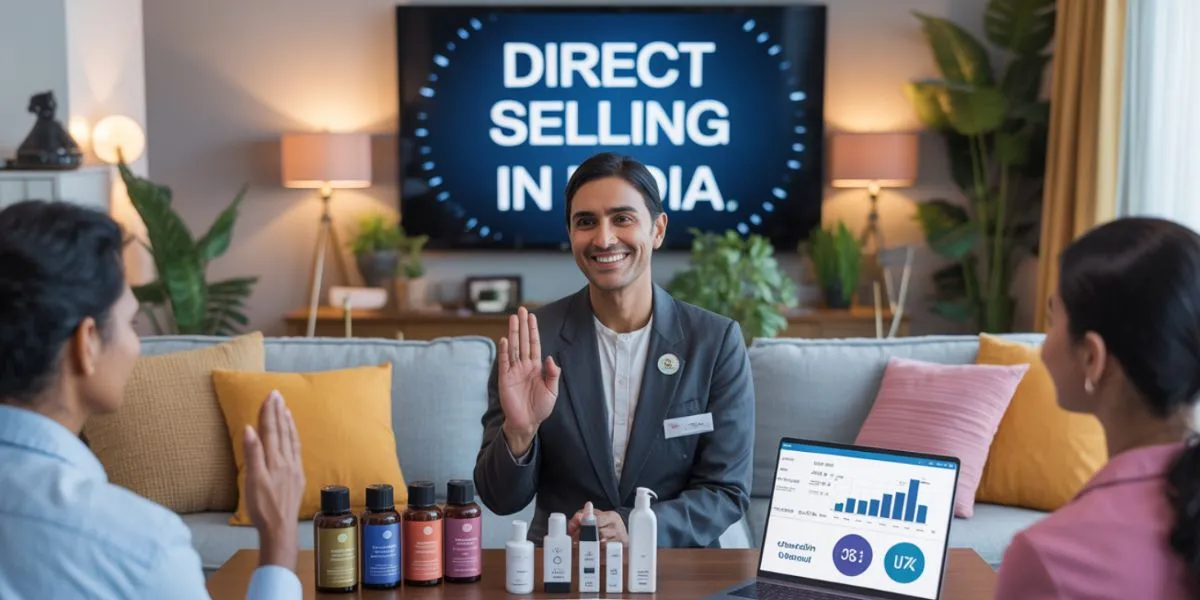
Giving up the renting of a shop and staff, imagine being able to make money using your phone, at your own time. No boss. No fixed hours. Only you, your network and something that people want. That is the fundamental concept of direct selling in India; it is larger than most people tend to think.
You have likely heard about Amway, Herbalife, or Vestige. Perhaps one of your cousins or neighbours attempted to enrol you in one. Perhaps you have questioned whether it is a legitimate scheme or another scam. However, whatever you might have thought about it, the statistics of this industry in 2026 are likely to shock you.
The following four figures provide a setup:
The direct selling in India officially attained the 30,000 crore mark by March 2026 upon the announcement of the same by Union Minister Pralhad Joshi – a significant achievement of the industry.
With a five-year CAGR of 7.15%, the industry has recorded an all-time high of 22,142 crore in FY 2023-24, which is an increase of 7.15% over the 16,800 crore in FY 2019-20. This is one of the industries that is most dominated by women in India, since 70 per cent of the direct selling workforce is made up of women.
In India, the direct selling market will take up 5.7 per cent of the total worldwide market in 2025, and the market will grow at a CAGR of 8.4 per cent between 2026 and 2033.
And yet, believe this to be aunties selling Tupperware? Think again. It is an actual, controlled and fast-emerging industry. Let’s understand the future of Direct Selling in india properly.
What Is Direct Selling?
Direct selling is simply selling to the customer, without a retail outlet, without an intermediary, without a distribution chain. Under traditional shopping, the product moves through the distributor, dealer, retailer, manufacturer, and customer. Four stops short till it gets to you. Each stop adds cost.
In direct selling in India, the process is easier: manufacturer, direct seller, customer.
The direct seller is a person, a common man, who purchases products of a company and sells them to friends, family or the community he/she lives in. They receive commission on each sale. Other businesses also allow merchants to form a team and reap the profits of their team’s sales as well – it is referred to as multi-level marketing, or MLM.
Imagine that you are a salesperson of a brand, but you are your own boss. You make your own time, select your own clients and develop at your own speed. The usual items which are sold this manner in India are health supplements, skin care, home care products, nutrition shakes, and kitchen essentials.
Current Market Size of Direct Selling in India
The direct selling in India has been expanding steadily, yet in the shadow for the past one hundred years. And it is currently in what most observers are calling the most exciting period in its history.
The industry reports show that the sector has hit about ₹64,500 crore (about 7.98 billion) by 2025 and is expected to go further to about ₹74,000 crore (about 8.9 billion) by 2026.
In perspective, that is over and above the annual earnings of some of the largest companies in India, which are listed on the stock exchange.
The northern part of India has a lead of 29.8 in terms of gross sales, followed by the East at 24.2, the West at 22.4, the South at 15.3, and the Northeast at 8.3. Maharashtra has the largest share of 13 per cent, West Bengal is in the second position with a share of 11.3 per cent, Uttar Pradesh with a share of 10 per cent, Bihar with a share of 6.2 per cent and Karnataka with a share of 5.7 per cent.
That is a pan-India business, alright – not metros only. The main contributors include such states as UP, Bihar and Bengal.
Some of the largest players that are pushing this market will be:
- Amway India- The world leader that has products in nutrition (Nutrilite), skincare (Artistry) and home care. It is one of the most reliable brands in the space.
- Vestige Marketing- A company with Indian roots established in 2004, with 12-40 crore revenue in 2024 and a rapidly expanding network of distributors throughout the nation.
- Modicare – This is another domestic firm established in 1996 by Samir Modi. Cheap goods, extensive coverage and especially good in the tier-2 and tier-3 cities.
- Herbalife India- Powerful in nutrition, protein drinks, and diets. Extremely popular among fitness-based consumers.
- Mi Lifestyle- Mi Lifestyle is one of the most rapidly expanding Indian direct selling companies that has been in operation since 2013.
They are actual and registered businesses under the Indian laws. Not fly-by-night schemes.
Future of Direct Selling in India (2026-2030): Future outlook
The direct selling boom in India is not yet complete. It is only the beginning, as far as I am concerned.
It is projected that by 2033 the direct selling market in India will experience a revenue growth of US 26, 313, 1 million with a CAGR of 8.4 between 2026 and 2033. It is projected to reach US 20 billion in the market by the year 2029.
What’s pushing this growth?
To start with, there is the rapid growth of the middle class in India. The increase in the number of individuals who have disposable income to spend on wellness, personal care, and quality home products is the most sold in direct selling.
Second, access to the internet has been made available in all parts of the nation. A small town distributor with Bihar can now conduct their whole business by use of WhatsApp, Instagram, and YouTube, but with no physical outlet.
Third, the government swept the rules. The Consumer Protection (Direct Selling) Rules, 2021 regulated the field seriously. These regulations allowed distinguishing between the legitimate business and the suspect operations and were obligatory to be registered by the government and have open compensation packages.
The industry is also aimed at achieving the target of 1.8 crore sellers by the year 2026, with strict observance of consumer protection, as well as publicity towards the distinction between the actual direct selling and the pyramid schemes.
Key Trends Shaping the Industry
The Industry is facing key trends that have shaped the industry.
1. The Social Commerce Is Checking Out
They are purchasing what they watch in Instagram reels and YouTube videos not only by influencers but by regular sellers that they subscribe to and trust. Virtual product demonstrations and live-streaming on social media enable sellers to make contact with customers in India in real time. In India, particularly, WhatsApp groups are the strongest sales tool that most distributors rely on day in and day out.
2. The Star Category under health and wellness
The greatest revenue-earning segment in 2025 is the health and wellness segment, which has a share of total industry revenue of 42.76%, whereas the most rapidly expanding segment in the future is the cosmetics and personal care segment. Immunity boosters, protein supplements and natural skincare have become of great interest to post-pandemic India and direct selling companies are ideally poised to do so.
3. New Growth Engine Are Tier-2 and Tier-3 Cities
The metros are already somewhat congested. The actual target now is in the city of Patna, Indore, Coimbatore and Guwahati, where the penetration of traditional retail is low while smartphone penetration is high. The companies of Indian origin such as Vestige, Mi Lifestyle, Modicare, and IMC Business are taking the lead in penetrating to smaller cities.
4. Tech-Enabled Selling
Most of the leading companies have adopted instant payment systems through e-wallets to appeal to the Gen Z and Millennials. Digital training platforms/ apps and AI product suggestions are taking the place of the ancient pamphlets and clumsy house meetings.
5. Make in India Push
By 2025, Amway will commemorate 10 years of Make in India production, and by 2026, it will have invested 12 million in new store facilities and India research and development. India is being considered as a manufacturing as well as a leading growth market by more global brands.
Is Direct Selling Profitable in India?
This is the question that everybody would really like to know. Let’s be straight about it. Yes, it may be profitable, just not to everybody and not in one day.
Here’s the real picture:
Under the first year, a first-time direct seller in India would earn between 5000 and 20000, depending on the effort, network, and product demand. It is more of a part-time second income initially.
In the long run, constructors of real teams and steady customer base may receive between 50,000-2,00,000 every month or beyond. The best in such firms as Vestige and Amway make in the lakhs monthly – but they are a handful who have worked years.
The industry has already given self-employment to 3.4 million women distributors, and the figure is likely to increase to 18 million direct sellers all over India, thus satisfying the international standards. Such a scale is a sign that it is real income to real people, not a fantasy.
What is the difference between success and failure? Three things: do it every day, a real product that people are really interested in and a sponsor who takes you through the ropes. When a company encourages you to hire instead of to actually sell products, that is a red flag, not an opportunity.
The cost of entry is also minimal. The joining kit or purchase needed to start is usually between 500 and 5,000 rupees, depending on the brand and the starter plan of most companies.
What Is the 3-3-3 Rule in Sales?
This is a very easy rule that can be a game-changer in case you are new to direct selling.
The 3-3-3 Rule is a discipline of selling per day. This is what it would appear like in a direct selling situation in India:
- Talk to 3 new people every day. Not to necessarily sell your product, but simply be in touch. A phone call, a follow-up text or even a real check-in.
- Make 3 follow-ups a day on existing leads or customers. The bulk of sales is not made on the first contact. People need time. Follow-ups are made on warm and regular instructions and it is these that bring interest to income.
- Invest 30-minute time on personal growth a day. Watch a training video. Get information about your product. Improve your communication. It is the sellers who continue learning that continue to grow.
- The 3-3-3 rule keeps things simple. It makes you not feel confused and leaves you with a daily routine to live by. Consistency is always better than intensity in a direct sell.
Is Direct Selling Good or Bad? (Pros & Cons)
The hype on either side can be set aside, and this can be looked at.
The Good Side (Pros)
- Low barrier to entry. It requires almost no amount, starting with less than 5000 rupees; almost anyone can do it: a student, a homemaker, or a retired man. No rental fee, no workers, no huge initial cost.
- Flexible working hours. You work when you want. This is particularly appealing to women who are home managers, students seeking part-time jobs and working professionals who seek a side hustle.
- Women’s empowerment at scale. About 70 per cent of the direct selling workforce in India is women. This industry has provided women, to a large extent in small towns, with real independence in terms of finances, without having to travel out of their own homes and even families.
- Actual products have real demand. Such companies as Amway, Herbalife, and Vestige present goods that people have a need for and buy over and over again. It’s not just selling air.
- Protection by the government is now in existence. The 2021 regulations have rendered the operations of the fraudulent companies extremely challenging. As a seller, as a buyer, you have legal rights.
The Not-So-Good Side (Cons)
- The initial income is not homogeneous. Direct selling is not a wage. Most people realise a meaningful income after 6 to 12 months of hard work.
- Pyramid schemes still exist. Not all companies which declare to be a Direct selling business are companies that are legitimate. When a company earns the majority of its earnings through recruitment fees instead of selling its products, then it is a pyramid scheme – avoid it.
- Relationship strain. The easiest way to rupture friendships and family ties is to pitch products to people who are not interested in them. Smart sellers target individuals who have expressed actual interest as opposed to making cold calls to all the contacts on the list.
- High dropout rate. Many are hoping to join it with high hopes, but they find it hard in the first few months and quit without even trying it. This is usually caused by unrealistic expectations of income.
- Pressure to overstock. Other companies encourage distributors to sell large quantities of inventory to get bonuses. The recent regulations of 2021 bar this, but not all the companies are guided by the good intentions of the law.
Role of Digital Marketing in the Future of Direct Selling
Here is one thing that has essentially transformed the game on the part of direct selling in India: digital tools can now be fully availed to an average individual.
Five years back, customer base building was done through face-to-face interactions by going door to door, home demonstrations, and cold calls. A 22-year-old in Lucknow can today create a group of 50,000 people on Instagram and sell wellness products to customers in India, without having to see them in person.
The most potent tool is WhatsApp. Groups, broadcast lists, status updates — whole businesses of Indian direct sellers are operated with the use of WhatsApp only.
Product discovery is being fueled by YouTube and Instagram Reels. When sellers explain their products in clear videos that are not too long and are honest, trust is achieved much faster than when a seller talks face to face.
Long-term sellers are gaining followers who visit them on autopilot with the help of blogs and Google SEO.
According to the DSA Growth and Outlook Survey, it is estimated that in 2025, direct online selling channels would be adopted by 79% of the direct selling in India which would also incorporate D2C models to boost margins and access customer segments beyond the traditional representative network.
It is the seller who integrates authentic personal connections with intelligent digital-based marketing that ultimately succeeds in 2026.
Training was also changed by using digital means. The new distributors do not have to go to weekly face-to-face meetings. They take video calls, online classes and company applications wherever they are.
Challenges & Risks in Direct Selling
There is not a single industry that can go without its problems. The following are some of the things that you need to know beforehand.
1. Pyramid Scheme Confusion
The most significant issue for the whole industry is the perception of society. Due to the numerous scams involving pyramids with the term of direct selling or network marketing having been used, many people are sceptical in India. This is detrimental to the good firms and sellers who are honest.
The basic test: when the primary income of a company is derived not through selling of products to the final and actual consumers but through recruitment fees, it is a pyramid scheme and not direct selling.
2. Interstate Regulatory Loopholes
Although there are central consumer protection rules, not all states have implemented them completely. This poses a problem of mismatch and uncertainty among companies, as well as individual sellers who are selling across states.
3. This is due to high dropout rates among new sellers.
The majority of those who enter a direct selling company drop out after six months. Their unrealistic income expectations, insufficient training by their sponsor, and the embarrassment of selling to people they know personally are the major causes.
4. Digital Skill Gaps
Whereas metro-based dealers have adopted digital dealings, most distributors in smaller cities have been using outmoded practices. Those companies investing in educating their networks on basic digital marketing are moving at a faster rate.
5. Lack of Income Transparency
The average earnings of the seller are not evidently revealed in every company. Always request them to provide their official income disclosure statement before joining any company. This is published in all legitimate companies. When they do not possess one – or when they are not disposed to provide it – then you have all you want to know.
Future Opportunities for the Beginners
This is where the actual opportunities lie, in case you think you would like to start in direct selling in 2026.
- Health and Wellness Products– This is the fastest-growing segment at present. In 2025, the health and wellness segment contributed to 42.76 per cent of all industry revenue. The supplements popular with the aging demographic include protein supplements, immunity boosters and natural health products, which are popular with people of all ages in every region of India.
- Tier-2 and Tier-3 Cities– In fact, that is an advantage, as far as you live in the smaller city or town. Competition is not that high, and human beings are more accepting of personal word of mouth from a local. The second wave of growth will be rural and semi-urban India.
- Women Entrepreneurs– Women seeking to be self-employed under the influence of the government policy coupled with the flexibility of direct selling of goods makes this a good opportunity to women who would rather not interfere with home or family commitments to generate income.
- Young Professionals who can do everything digitally– When you know Instagram, YouTube, or WhatsApp marketing, you will be able to build a customer base in a short period of time as compared to any other generation of direct sellers. It is a practical, actual benefit that was not even in place five years ago.
- High Repeat Purchase Rate– Find the companies whose products are reordered by customers on an average basis- nutrition, personal and home care. A single customer who orders on a monthly basis has more value than ten single customers.
Final Verdict: Should You Start in 2026?
It is a yes in this case, but with the right expectations. Direct selling in India 2026 is a valid, licensed and expanding business. It has made millions of Indians (particularly women) in all the states of the country financially independent. Rules are more understandable than ever before. The tools that are present in the digital world today allow the creation of a customer base like never before.
Nevertheless, it is not a get-rich-quick venture. It is not passive revenue in the first place. It is not going to turn you into a lakhpati in three months. And it is not for everyone.
Assuming you can commit 12 months of sincere effort, working consistently, to it, allowing a full year of this honestly and without exception, and willing to sell instead of merely recruiting, be fully adherent to the regulations, and intelligently use digital solutions, then this is one of the least risky ways to earn a second income in India today.
When someone offers you 1 lakh a month in the first three months with minimum effort, then prepare to go. That is not direct selling. That is a trap.
Explore More About:
FAQs
Is direct selling in India legal?
Yes, completely. It is governed by the Consumer Protection (Direct Selling) Rules, 2021, according to which all direct selling companies are to be registered by the government, have transparent compensation plans and offer a fair refund policy.
Which is the best direct selling company in India that is the best to start with?
The companies such as Modicare, Vestige, and Amway are also easy to begin with as they require low entry costs, have good training assistance, and offer a variety of products with a high level of demand, which remains constant.
What is a pyramid scheme and direct selling?
Direct selling involves earning income through the sale of products to actual customers. In a pyramid scheme, the largest part of the income is collected through recruiting new members, paying them to join the scheme, with little or no product being involved.
What would an entry-level make when direct selling in India?
During the initial 6-12 months, the average income at the beginning is 5000 to 20000 a month in part-time income. Profits increase with consistent efforts and the size of the network.