
In 2026, cybersecurity is a game of chess, which keeps evolving. Several years ago, one could just install a powerful antivirus and go to sleep. Remote work is a given thing today, and there are smarter, faster attacks with the use of AI by hackers. Defenses that were old do not help. There are laptops, phones, and cloud servers that companies should be able to protect everywhere in the world. Endpoint Detection Response (EDR) tools come in handy.
The purchase of the appropriate EDR tools in 2026 is not a luxury; it is a necessity to survive. Attacks by ransomware have evolved from an easy theft of data to a complicated trick that has the capacity to halt world operations within a few minutes. The technologies that we are discussing are excellent digital guards that are based on machine learning, behavioral checks, and automation, to identify threats before they happen.
The market is misleading since all traders say that they are 100 percent protective. The noise is cut right through in this guide. We have looked at the most appropriate ones, where they stand in terms of addressing 2026 threats, ease of use by your IT department, and whether they are worth the price. The appropriate EDR is a move in the right direction to safeguard your digital future, whether you are a large international company or an up-and-coming business. Let’s start.
What Are EDR Tools in Cybersecurity?
EDR is an abbreviation used in the term Endpoint Detection and Response.
- Endpoint: An endpoint is any device that is connected to your business network in IT. It consists of phones, laptops, desktops, servers, and tablets. Smart thermostats or printers are also considered devices in 2026. All of them may serve as a gateway to hackers, such as a door that the hackers may attempt to break.
- Detection: It is the observing component. The old antivirus searches files of bad files that have been previously identified, such as querying a criminal database. EDR looks for bad behavior. To take an example, in the case Word document that attempts to erase your backups, an antivirus may not pick it up as it appears clean. An EDR tool observes that documents should not be deleted from the backups, and it is a threat.
- Response: This is the action part. There is no point in detecting a threat and not stopping it. EDR tools do not alert; they take action. They would be able to disconnect an infected laptop from the network so the virus and the computer do not infect each other. They are even able to roll back the computer to a safe position to undo the ransomware damage and block malicious software.
Top 10 Best EDR Tools for Enterprises in 2026
1. CrowdStrike Falcon
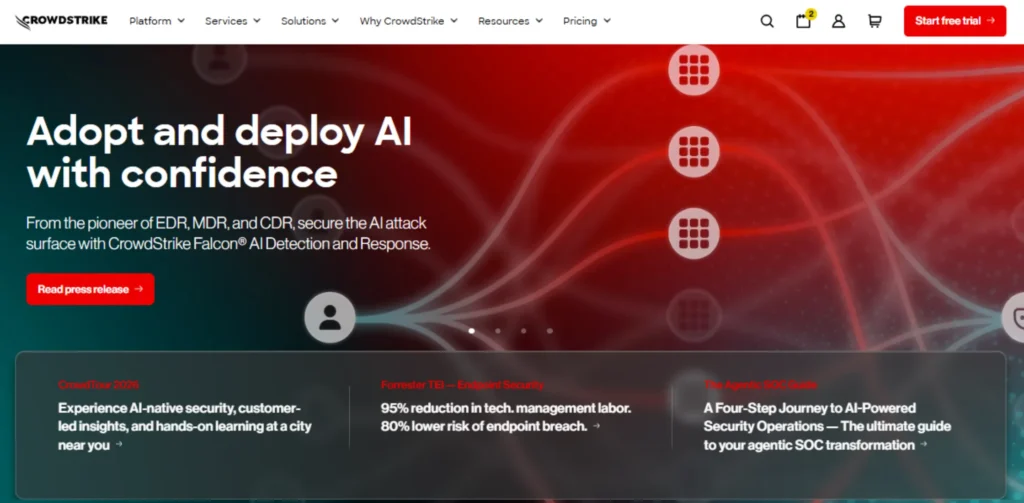
CrowdStrike Falcon is regarded as the most suitable option when it comes to computer security in 2026. It is completely cloud based, thus companies do not require intensive hardware in the premises. Its small agent can be installed fast on gadgets and does not slow it so that the employees can continue working and have high levels of security. The Threat Graph is a big cloud database that is used by Falcon, based on millions of computers worldwide. It is able to detect new risks within a few seconds.
When one firm is attacked, CrowdStrike gets informed about the attack and secures all the others immediately. The platform is highly customisable: as more companies enlarge their usage, they can add threat intelligence, USB device control, or identity protection. Its user interface is clean and simple to navigate and this helps security analysts to locate attackers quickly rather than lose track in logs. Most fortune 500 companies prefer Falcon as it is quick and efficient.
Key Features:
- Realtime Threat Graph: Martulik’s billions of events each week to prevent breaches in real-time.
- Charlotte AI: A generative AI security assistant: Find your threat with easy English-language questions.
- Live Visibility: provides a list of all devices and their activity in a single dashboard in real-time.
- OverWatch: Choose managed service, and have experts hunt down your threats 24 / 7.
- Network Containment: In one click tries to isolate a dangerous device off the network so that it cannot spread.
Best For: Massive enterprises that require speedy safeguarding, lightweight agents, and threat intelligence of high quality.
Pricing: Quote‑based. Typically packaged (Falcon Pro, Enterprise, Elite) at a base of about $1518 per device per month on an enterprise basis.
Website Link: https://www.crowdstrike.com
2. SentinelOne Singularity

Having a high level of AI and automation is a characteristic of SentinelOne. It is being sold as the set it and forget about the solution for modern businesses. The best part is the fact that it is fully functional even on a device, thus able to identify and prevent attacks even when one is not connected to the cloud or even when the laptop is working offline. This particularly comes in handy when the remote workers have patchy internet connectivity.
Its Storyline technology automatically connects the random occurrences together in an understandable sequence, so the analyst does not have to manually recreate the logs. One of the most popular edr tools functions is the so-called rollback; in case files are encrypted by the ransomware, SentinelOne could unencrypt the files with just a single click and restore them; data loss is eliminated.
Key Features:
- Autonomous AI: Detection and response are done at the agent and do not require the internet.
- OneClick Rollback: Ransomware invasion is quickly reversed, and destroyed or corrupted records are restored.
- Storyline Technology: Displays the specific who, wha,t and when of an attack.
- Singularity Data Lake: Gathers data of other security tools to have a bigger picture.
- Rogue Device Discovery: Is used to automatically discover devices on your network which are not managed.
Best For: Any business that would prefer a high level of automation and can achieve recovery in case of ransomware without using backups.
Pricing: Quote‑based. There are Core, Control, and Complete packages. Approximate cost is $6 12 per unit per month based on volume.
Website Link: https://www.sentinelone.com
3. Microsoft Defender to Endpoint.
Microsoft Defender for Endpoint is a highly rated security solution that can serve well in 2026, particularly in companies using Windows and Microsoft 365. It is presently embedded in Windows 10/11 and Office 365 and therefore does not require any additional installation. Defender blocks threats and predicts them with the help of Microsoft ecosystem information. It provides a closeup view regarding malware and software vulnerabilities, and informs you which apps are not uptodate and which are dangerous.
The tool also has automated investigation and remediation, which serves as a virtual analyst and fixes the alert without human input. It provides one unified security solution, which is convenient to use compared to those offered by third parties, to organizations witha heavy investment in Microsoft.
Key Features:
- Agentless Deployment: An inbuilt capability of windows hence no additional software or crashes.
- Vulnerability Management: Dynamically identifies and ranks software weaknesses.
- Microsoft Copilot on Security: AI-powered incident summary and advice to junior analysts.
- Automated Self Healing: Explores notification and resolves complex threats in minutes automatically.
- CrossPlatform Support: Does not just support windows but also macOS, Linux, Android and iOS.
Best For: Companies with a strong commitment to Microsoft 365 and a need to have a single security stack.
Pricing: Microsoft 365 E5 includes. Plan 1 is on its own; it costs approximately 3 dollars per user month; Plan 2 (full EDR) costs approximately $5.20 per user month.
Website Link: https://www.microsoft.com/enus/security/business/endpointsecurity/microsoftdefenderendpoint
4. Palo Alto Networks Cortex XDR

The industry has been transformed by Palo Alto Networks with its invention of XDR (Extended Detection and Response). Their Cortex platform continues to be the leader in 2026 as it connects the various layers of security. Standard EDR tools will only monitor laptops, but Cortex XDR will retrieve information on firewalls, cloud, and endpoints to provide a complete view of network activity. This matters since a great number of sophisticated attacks are transferred outside the network onto the device.
It is regarded as the tool of Root Cause Analysis, a timeline of the attack is displayed in order to enable analysts to observe how the break was initiated specifically. It applies accurate behavioral analytics to locate unusual events, including a user who logs into his account at 3 AM in a different country. In the event that a company is already using Palo Alto firewalls, the integration of Cortex XDR will make the network one smart defense that prevents threats simultaneously in every point.
Key Features:
- Network & Endpoint Unification: It consolidates the information of firewalls and devices so that you can have a better view.
- Identity Threat Detection: It detects stolen logins and insider threats, based on user behavior.
- SmartScore: It assigns each incident a risk score to enable the analysts to determine the first one to address.
- Managed Threat Hunting: A service requiring Palo Alto experts to hunt through your system.
- Host Insights: It provides detailed views of the IT health, such as the checks of the weaknesses, and an assets list.
Best For: The product is best suited to companies that require a high visibility of network security and already have Palo Alto products.
Pricing: By quote. More generally due to premium, crossplatform features.
Website Link: paloaltonetworks.com
5. Sophos Intercept X

Sophos Intercept X is a powerful product that is beloved by midsize companies and small teams of IT experts due to the provision of advanced protection and high ease of use. Its Deep Learning neural network that detects malware without signatures and its antiransomware special feature CryptoGuard are also well known. CryptoGuard monitors unauthorized encrypted files of the ransomware symptom and prevents it immediately, then returns the files to their original condition.
There is also Adaptive Attack Protection by Sophos, which strengthens the defenses of the same when an endpoint is under attack. The management console, Sophos Central, is also cloud-based with integrated cloud storage, user-friendly and provides the capability to administer endpoints, mobile devices, and even firewalls centrally. It simplifies high-end security without the need for a PhD in cybersecurity.
Key Features:
- Cryptoguard: which prevents ransomware and restores encrypted files.
- Deep Learning: Discovers the known and novel malware without the use of signatures.
- Synchronized Security: This feature permits the devices and Sophos firewalls to communicate to isolate infected devices.
- Adaptive Attack Protection: feature activates a more intense shield in case a device is being attacked.
- Root Cause Analysis: Displays the attack chain in the way you are able to see where it started.
Best for: Medium and large organizations and managed care providers interested in having a high degree of protection against ransomware.
Pricing: By quote. In general, affordable, approximately at between $2040 per user per year, based on package.
Website: sophos.com/enus/products/endpointantivirus.
6. Trend Micro Vision One
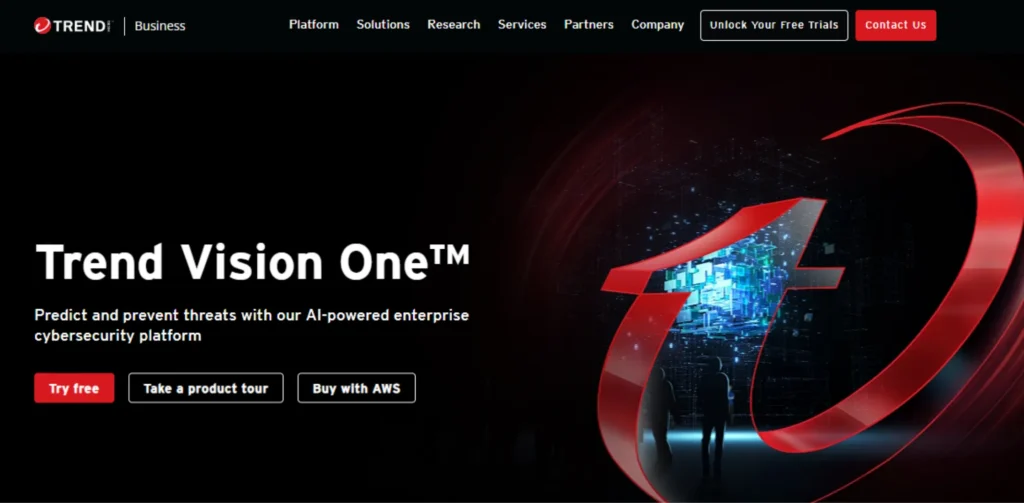
Trend Micro Vision one (formerly Apex One endpoint) is also one of the edr tools which is most useful in hybrid environments where an organization has older servers and new cloud applications. It provides security not only of the outdated Windows servers but also of the current containerized applications. Vision One is extolled due to its virtual patching that prevents attacks to the vulnerable software prior to IT installing the official patch and this is a savior to oldfashioned companies.
XDR analytics are being used to connect email, server, and device alerts on the platform, reducing the noise that analysts have to deal with. It is primarily a defensive mechanism, aimed at making the environment resistant to attacks occurring, and still providing good investigation tools should anything go awry.
Key Features:
- Virtual Patching: Prevents softwarebased attacks immediately and availability of official patches allows IT time to implement them.
- Attack Surface Risk Management: Continues to assess and demonstrate the location of the risks in the company.
- XDR Sensors: Collects and connects activity data on email, devices, servers, and workloads in clouds.
- Generative AI Companion: This App is a plain language execution of alerts based on the inference of the complex scripts.
- Mobile Security: This is well integrated and it secures mobile devices on the corporate network.
Best For: Companies that have both hybrid and legacy systems and require virtual patching.
Pricing: By quote. Credit system based competitive enterprise models, with a variety of sensors.
Website Link: https://www.trendmicro.com/en_us/business/products/oneplatform.html
7. VMware Carbon Black (Broadcom)
Carbon Black is also a subsidiary of Broadcom and is still among the best EDR tools, especially in the regulated industries such as banking and government. It concentrates on application control, it does not only search malware but also secures the system so that it can only allow approved software to be used. This is a powerful default Deny technique of protecting critical servers that cannot sustain downtime or a tradeoff.
Carbon Black records not only suspicious activity but also everything on an endpoint. That log history allows forensic software developers to reenact attacks step by step. It is also more skilled to utilize compared to other tools, yet the data and control level is detailed, and it is what teams that require total visibility of all the processes and file alterations will have.
Key Features:
- Advanced surveillance: captures the activity of all endpoints 24/7 just like DVR when used in security.
- Application Control: secures vital servers against unauthorised programs.
- Live Response: allows security teams to safely remotely access their infected devices and correct them.
- Threat Hunter: highend hunting utilities to locate attacks that are not defined as malware.
- Noncontact Remediation: corrects the problems without having to restart the computer or interrupting the user.
Best For: Mature SOCs and controlled industries that require deep forensics.
Pricing: Quote-based. Normally at the higher end due to its high forensic levels.
Website Link: https://www.broadcom.com/products/carbonblack
8. Bitdefender GravityZone
Bitdefender GravityZone is one of the capable EDR tool device, which receives prevention awards and has a userfriendly interface. It operates at a low friction rate it automatically captures most threats without soliciting the assistance of the team. Instead, its preventionfirst architecture applies tunable machine learning to prevent threats at the earliest stages, thus the EDR component has less work to do.
GravityZone is effective in displaying attacks in explicit graphs that connect the infected file, email and web address. Bitdefender offers the best security and low workload, which is popular among lean IT teams of firms without large security teams.
Key Features:
- HyperDetect: machine learning models which can be configured to go paranoid or permissive.
- Risk Analytics: examines user behavioral patterns such as weak passwords to determine the points of future breaches.
- Human Risk Analytics: users that are engage in a risky manner are identified.
- Incidents Visualization: displays attacks in a kill chain that is clearly and graphically presented.
- Low Impact Resource: operates on low-performance hit endpoints.
Best For: Companies that require prevention based, high accuracy, and low administration overhead.
Pricing: Easy to understand: enterprise plans are priced at $3050/ year/ device.
Website Link: https://www.bitdefender.com/business/enterpriseproducts/endpointdetectionresponse.html
9. Cisco Secure Endpoint
Cisco Secure Endpoint, which was previously known as AMP of Endpoints, is powerful among those EDR tools companies that operate all Cisco hardware. Its principal strength is that it collaborates with Cisco Talos, the largest open threat intelligence agency. A new threat is blocked immediately when Talos is made aware of it by all Cisco Secure Endpoints.
It can be used to trace the path that a file has taken over the network, identifying the first infected computer (patient zero) and all other locations that it has infected. It is also integrated with Cisco SecureX, which provides one perspective of endpoints, cloud, and network. To the engineering team that deals with security, it saves time to have endpoint data displayed next to the firewall data on the same dashboard.
Key Features:
- Talos Intelligence: industryleading research based on current protection.
- Orbital Advanced Search: issue complicated queries to all endpoints in order to locate particular threats.
- Device Trajectory: monitors the progress of a file in the network.
- Retrospective Security: warns you when a file that you had considered safe, turns out to be malicious.
- SecureX Integration: integrated with the unified security platform at Cisco.
Best For: Firms with a Cisco-based network infrastructure.
Pricing: Quote sold as a subscription, 1, 3 or 5 years.
Website Link: https://www.cisco.com/site/us/en/products/security/endpointsecurity/secureendpoint/index.html
10. Elastic Security
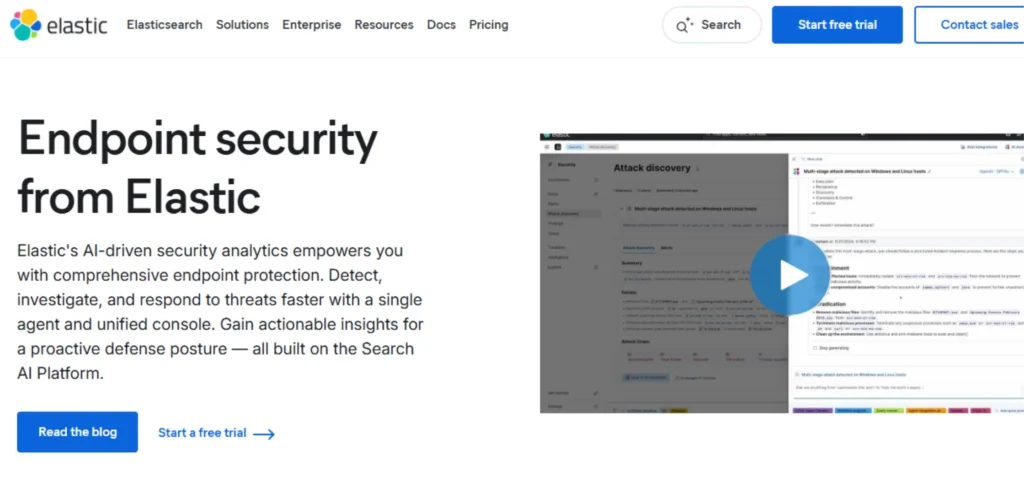
Elastic Security, an ELK Stack based game changer, is an advanced team. It is accessible and therefore detective teams can view and modify detection rules. It unites SIEM and EDR into a single agent, thus being able to log data and prevent malware using just one tool. It can search large data sets very fast and this assists threat hunters to query many endpoints in a short period of time.
Elastic has a free plan to use it on a basic level, with enterprise features being an additional charge. It is targeted to builder companies with the DevSecOps mentality that desire to tailor their security tool.
Key Features:
- Loans Taken: It is the feature that allows simultaneous analysis of logs and endpoint protection in a single platform.
- Open Detection Rules: detection logic can be viewed, edited and assisted by users in creating detection logic.
- Unlimited Scalability: it is based on Elasticsearch, which means that it can process large volumes of data without any difficulties.
- Pre Engineered Protections: is provided with hundreds of pre engineered common attack rules.
Best For: Companies with a high level of customization, DevSecOps personnel, and technical analysts.
Pricing: Dynamic, depending on the amount of data you consume as well as per endpoint.
Website Link: https://www.elastic.co/security/endpointsecurity
How to Choose the Right EDR Tool
The selection of an appropriate EDR tools is similar to the purchase of a suit: It needs to match your needs precisely. What is effective in a large bank might not be effective in a small store. This basic advice will enable you to select the optimistic one in 2026.
1. Reflect on the level of skills of Your Team.
The last consideration that matters the most is the users of the tool. When you have a specific security team that likes to dig logs, then strong tools such as CrowdStrike, Palo Alto Cortex, or Elastic are of your choice.
2. Examine Your Current Ecosystem.
Do not attempt to impose a tool that will not fit into your existing systems. When your company is fully implemented on Microsoft 365, then Microsoft Defender for Endpoint would usually be the simplest and the least expensive option, as it will integrate with what you already have.
3. OS Support Matters
Windows is not the only business used in 2026. You can have Mac developers, Linux servers, and iPad salespeople. Ensure that the EDR tool has all these systems. SentinelOne and CrowdStrike have a reputation for good macOS and Linux support. Even some of the older tools are still challenged with anything beyond Windows.
4. Cloud vs. On‑Premise
A majority of contemporary EDRs operate in the cloud, and therefore, they can be managed using a web browser. In case you work in a government agency or a defense contractor that is not able to use the public cloud, you might also require a self-hosted solution such as Broadcom Carbon Black or Elastic on-premises.
5. Budget and Pricing Models
EDR pricing can be confusing. There are those vendors who charge per device, and there are those who charge based on the volume of data that they process. Be aware of additional costs on basic capabilities like USB control or threat intelligence.
Conclusion
The security of a company in 2026 will be determined by how good the endpoint protection is. Old-style antivirus can no longer suffice. What you require is an EDR that tracks down threats, identifies them, and prevents them.
Pick either the self-driving power of SentinelOne, the fit of the ecosystem of Microsoft, or the speed of CrowdStrike, but the crucial point is to start. AI and automation have already become a tool in the hands of wrongdoers to identify weaknesses. You have to be as smart in your defense. Get the needs of your team, get a demo of your top three and equip your business with the defenses it warrants.
FAQs
The outside difference between EDR and Antivirus?
Antivirus is like a bouncer who merely verifies a list of people who are not allowed. EDR is comparable to a guard that monitors the entire crowd, and individuals who sit on the list but are suspicious are caught.
Should I have Antivirus in my case or not with EDR?
Next-generation antivirus is typically provided with most contemporary EDRs, which means that you typically only require a single product.
Does it mean that EDR can fit small businesses?
Yes. Managed EDR services (MDR) or highly automated tools like Bitdefender or Sophos should be sought by small businesses to avoid having a full-time security analyst.
Can EDR tools stop ransomware?
Yes. EDR tools are the most effective protection against ransomware as they are able to identify encryption activity immediately and, in most instances, roll back files.