
It has never been simpler to start an online store than nowadays, and open source e-commerce software contributes significantly to the same. It provides you with the means to develop, maintain, and expand a store without having to spend thousands of dollars on the licenses of e-commerce software. These are available to much more than just the small business owner, the developer, or the startup founder. The design is customizable, and you can enable new features and get the platform to work just the way you desire.
By 2026, open source e-commerce software will have been carried to an even higher level. They are in favour of modern payment systems, mobile shopping, AI-based tools, and so on. And the best part? Their improvement is always being done by a large community of developers. This guide will take you through all the information you need to know – what open source ecommerce platforms are, and the top 10 best platforms that are currently available.
What Are Open Source E-Commerce Platforms?
Open source e-commerce software are open source applications that allow everyone to develop an online shop. Their code of behaviour is open and accessible to all. The software can be downloaded, used, modified and shared freely. You do not have to be tied down to the rules or the prices of one company as is the case with paid platforms. You are the one who runs the store; you have all the control over it: its data, its design, and its features.
Key Features of Open Source E-Commerce Platforms
- Comprehensive source code access — Open, modify and freely customise all the code.
- Customizable Store Design: Change themes and layout to fit your brand.
- Extension and Plugin Support — Add extensions to your site at will with easily installed extensions.
- Multi-Currency and Multi-Language Support – Sell to customers in any nation across the globe.
- Smooth integration with Payments — Integrate with popular payment methods.
- Inventory and Order Management Track Stock, orders, and shipping.
Benefits of Using Open Source E-commerce Platforms
- No Monthly Subscription Fees — The software is free to use.
- Complete Control of Your Store – Make any changes that you wish.
- Massive Community of Developers Support: Use the support of thousands of active developers.
- Grow with Your Business — Expand without difficulty.
- Good Data Privacy and Ownership: Your customer data remains with you alone. Stores serving Indian customers can also use the best UPI QR code generators to make payments faster and more convenient at checkout.
- Free and Paid Thousands of Plugins — Enhance your store with no coding.
Challenges of Open Source E-commerce Platforms
- Technical Skills Usually Needed – Non-developers can find it difficult to set up.
- You deal with Hosting and Security Server management is your business.
- Maintenance Requires a Human Touch — Software maintenance is a demanding activity.
- Expenses may become cumulative in the long run — Hosting, plugins, and support are not necessarily free.
- Minimal Support by the Official Customer Support of the Company — The majority of the support is provided by community forums.
Types of Open Source E-commerce Platforms
- Self-Hosted Sites — You download the software and operate it on your own server.
- Headless Commerce Platforms – It separates the frontend and the backend so that they are flexible.
- B2B-Specialised Platforms — created with the purpose of not targeting individuals but businesses.
- Marketplace Platforms – Every marketplace has several sellers sharing one storefront.
- Lightweight and Simple Platforms – The models are intended to be used in small stores with simple needs only.
Top 10 Best Open Source E-commerce Software in 2026
1. WooCommerce
Rating: 4.7/5
Website: https://woocommerce.com/
Best Use Cases: Best for WordPress users building small to large stores.
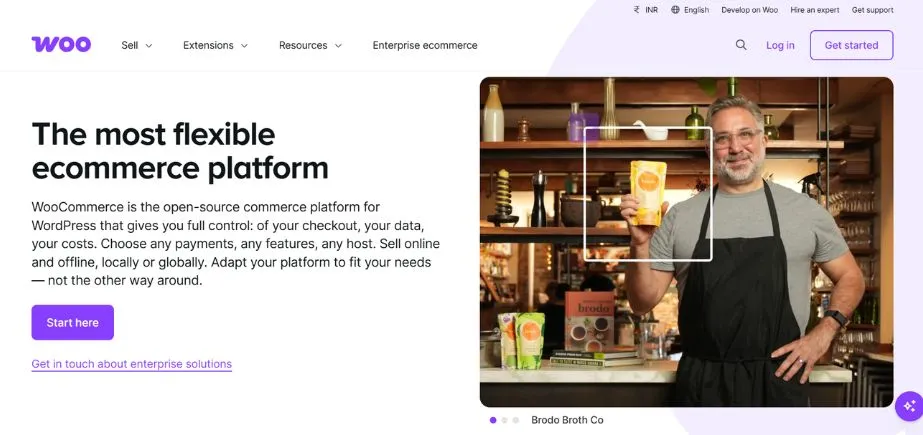
In the world, WooCommerce is the best open source e-commerce software. It is a WordPress-run plugin, which means that in case you already have a WordPress site, it is extremely simple to create a store. It has thousands of free and paid themes and support. You are able to sell both physical goods and digital downloads, subscriptions, and so forth. It is user-friendly and boasts a huge user and developer community that is always willing to assist.
Key Features:
- Works with WordPress
- 1000+ plugins available
- Flexible product types
- Built-in analytics dashboard
- Easy payment setup
Pros:
- Very easy setup
- Huge plugin library
- Free to use
Cons:
- Needs WordPress knowledge
- Can slow down with size
- Costs grow over time
Pricing: Free
2. Magento (Adobe Commerce Open Source)
Rating: 4.5/5
Website: https://business.adobe.com/products/magento/open-source.html
Best Use Cases: Best for large businesses needing powerful, custom e-commerce solutions.
The Magento Open Source is a robust online store platform, designed to support large and complicated stores. It provides you with intense control of your store. You are able to manage thousands of products, stores and complicated pricing policies under a single location. Big brands globally use it. The platform is highly operational and requires a professional developer to install and run it in an appropriate manner.
Key Features:
- Multi-store management
- Advanced product catalogue
- Custom pricing rules
- Strong SEO tools
- Large extension marketplace
Pros:
- Very powerful features
- Highly customizable
- Great for large catalogues
Cons:
- Needs developer skills
- High server requirements
- Complex to maintain
Pricing: Free
3. PrestaShop
Rating: 4.4/5
Website: https://www.prestashop.com/
Best Use Cases: Best for small to medium stores looking for easy European market support.
PrestaShop is the most widespread open source e-commerce software that is trusted by more than 300,000 shops worldwide. It is particularly widespread in Latin America and Europe. The platform is loaded with numerous inbuilt applications such as product management, promotions and multi-language. It is not heavy as compared to Magento but does have good tools to expand stores. It is quite easy to get started even when one has minimal technical expertise.
Key Features:
- 600+ built-in features
- Multi-language support
- Mobile-friendly design
- Product reviews built in
- Active module marketplace
Pros:
- Easy to get started
- Strong multilingual support
- Good European market fit
Cons:
- Paid modules get expensive
- Limited free themes
- Support is an extra cost
Pricing: Free
Also read: Best Product Based Companies in India
4. OpenCart
Rating: 4.3/5
Website: https://www.opencart.com/
Best Use Cases: Best for beginners wanting a simple, lightweight store setup.
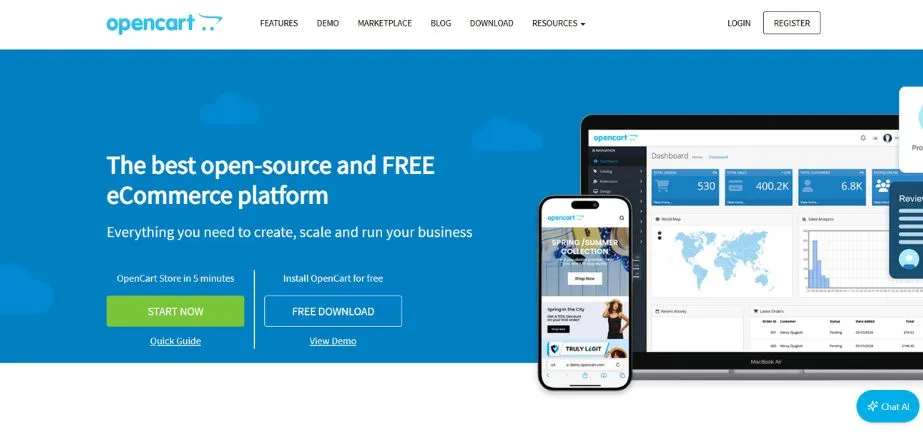
OpenCart is one of the lightweight, clean and simple open source e-commerce software options. It suits individuals who are new to running an online store. You do not require any serious technical expertise to install it. The administrator panel is user-friendly. OpenCart has support for multiple stores, multiple currencies and numerous payment gateways. Although it is not as mighty as Magento, it is an excellent option to use in the small to medium stores that need something easy and quick.
Key Features:
- Simple admin dashboard
- Multi-store support
- 36+ payment gateways
- 8+ shipping methods
- 13,000+ extensions
Pros:
- Very beginner-friendly
- Lightweight and fast
- Large extension store
Cons:
- Fewer advanced features
- Outdated default themes
- Limited scalability
Pricing: Free
5. Sylius
Rating: 4.4/5
Website: https://sylius.com/
Best Use Cases: Best for developers building custom e-commerce projects with PHP and Symfony.
Sylius is a current open source e-commerce software that is based on a Symfony PHP framework. It is aimed at the developers who wish to create online stores that are highly customised and constructed at the ground level. It cannot be considered a plug-and-play solution; it needs knowledge of code. However, to developers, it is a dream tool. All elements of the platform can be customised or modified. It is excellent in companies whose conditions are very unique, and other platforms would not be able to provide.
Key Features:
- Built on the Symfony framework
- Fully modular design
- API-first architecture
- BDD test coverage
- Headless commerce ready
Pros:
- Extremely flexible code
- Great for developers
- API-first by design
Cons:
- Not beginner-friendly
- Requires coding skills
- Small community size
Pricing: Free
6. Bagisto
Rating: 4.3/5
Website: https://bagisto.com/
Best Use Cases: Best for Laravel developers building fast, modern ecommerce projects.
Bagisto is a contemporary open source e-commerce software that is developed using Laravel and Vue.js. It is quickly gaining popularity, particularly among PHP developers. It is also equipped with a nice set of in-built capabilities such as multi-inventory, multi-currency and multi-channel capabilities. Bagisto is also equipped with a headless commerce and PWA shop window. It is a very good option in case you would like to have a fresh and modern platform with active and growing community.
Key Features:
- Built with Laravel and Vue.js
- Multi-channel selling
- PWA storefront support
- Multi-warehouse inventory
- REST and GraphQL APIs
Pros:
- Modern tech stack
- Fast-growing community
- Good out-of-box features
Cons:
- Smaller plugin ecosystem
- Needs Laravel knowledge
- Less enterprise-ready
Pricing: Free
7. Spree Commerce
Rating: 4.2/5
Website: https://spreecommerce.org/
Best Use Cases: Best for Ruby on Rails developers building API-driven custom stores.
Spree Commerce is a Ruby on Rails open source e-commerce software. It is completely API-first and is a good headless commerce backend. Spree is popular among developers as it is simple to extend and is modular. You are able to create mobile applications, bespoke fronts, or link them to any CMS without difficulty. Spree consists of decades of trusted architecture and clean codebase used by hundreds of businesses around the planet.
Key Features:
- Full REST API support
- Headless commerce ready
- Multi-currency support
- Modular architecture
- Active developer community
Pros:
- Clean API design
- Great for headless builds
- Solid Ruby on Rails code
Cons:
- Ruby on Rails required
- Smaller user base
- Limited ready themes
Pricing: Free
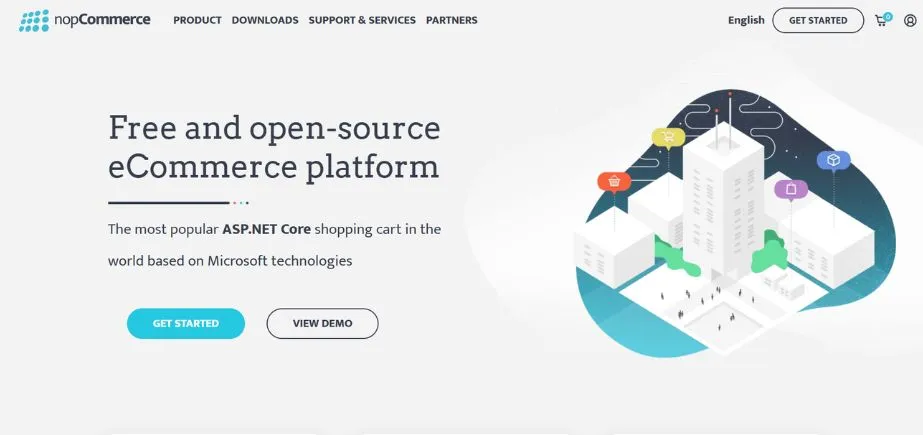
8. nopCommerce
Rating: 4.5/5
Website: https://www.nopcommerce.com/
Best Use Cases: Best for .NET developers building secure and scalable Microsoft-based stores.
nopCommerce is an open source e-commerce software that runs on the ASP.NET Core platform of Microsoft. It is among the finest options if your team operates with Microsoft technologies. The platform is secure, fast and highly maintained. It is equipped with functionality such as multi-store support, a product comparison tool, loyalty points, and a highly populated demonstration of extensive plugins in the market. nopCommerce is very popular among both B2B and B2C companies and has more than 60,000 stores in the world.
Key Features:
- Built on ASP.NET Core
- Multi-store management
- 500+ official plugins
- Strong SEO features
- Flexible tax management
Pros:
- Great .NET performance
- Strong security features
- Huge plugin marketplace
Cons:
- Best for .NET developers
- Hosting can cost more
- Steeper learning curve
Pricing: Free
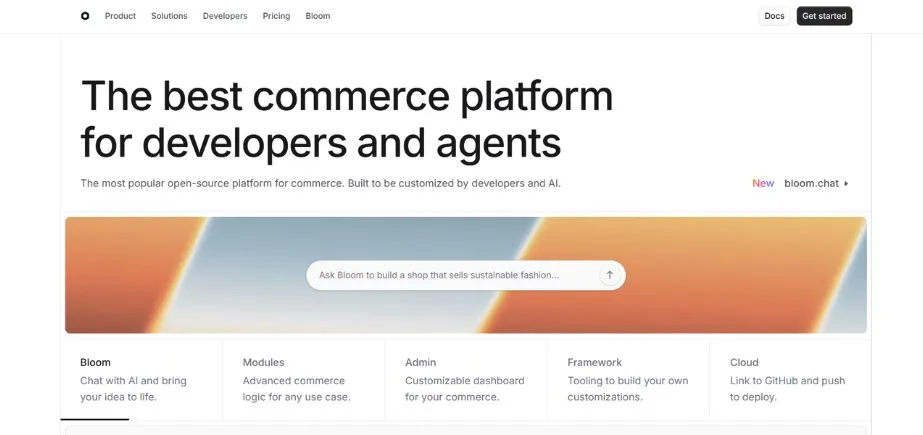
9. Medusa.js
Rating: 4.4/5
Website: https://medusajs.com/
Best Use Cases: Best for modern JavaScript developers building fast headless commerce projects.
One of the newest and most exciting open source e-commerce software options in 2026 is Medusa.js. It is being developed purely on Node and it is headless and API-first. The developers adore it due to its simplicity in installation and high level of flexibility. It can be used with any of the frontends, such as Next.js, Gatsby, or any other framework. It has been labelled the “open source Shopify alternative” since it provides the power of Shopify without charging a monthly fee.
Key Features:
- Node.js-powered backend
- Headless and API-first
- Multi-region selling support
- Automated workflows engine
- Plugin-based architecture
Pros:
- Easy for JS developers
- Very modern architecture
- Fast-growing ecosystem
Cons:
- Still maturing platform
- Limited legacy support
- Smaller plugin library
Pricing: Free
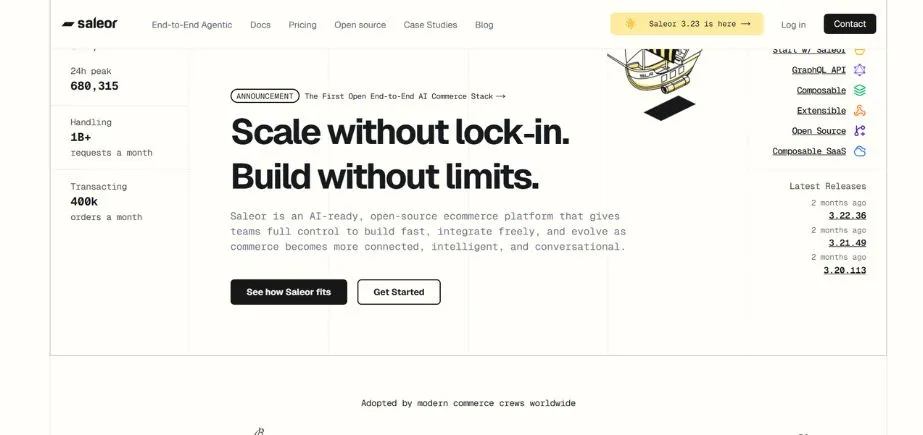
10. Saleor
Rating: 4.3/5
Website: https://saleor.io/
Best Use Cases: Best for Python developers building GraphQL-powered modern ecommerce apps.
Saleor is a Python and Django-based open source e-commerce software. It is based on GraphQL as its primary API, and it is an excellent match when a developer needs a versatile and rapid API-based store. Saleor is highly clean and user-friendly. It is out-of-the-box multi-lingual, multi-currency and multi-channel selling. It fits well with technology teams that desire a modern backend and affix it with whichever frontend they prefer.
Key Features:
- GraphQL-first API
- Multi-channel selling
- Composable commerce ready
- Built-in CMS tools
- Dynamic attribute support
Pros:
- Clean GraphQL design
- Great multi-channel support
- Modern Python codebase
Cons:
- Requires Python knowledge
- Limited plugin options
- Smaller community size
Pricing: Free
How to Choose the Best Open Source E-commerce Software
- First, Check Your Technical Skills — Choose a platform based on your level of coding experience.
- Consider Your Square Area — Little stores and big stores require quite distinct platforms. Product based companies in India looking to go online should pick a platform that supports local languages, Indian payment gateways, and GST billing.
- See Plugin and Theme Options – Saves time and cost of development.
- Take into account Hosting and Running Costs – even free software may be expensive to run.
- Check Community and Support Quality – A big, active community always refers to quicker help.
- Ensure it is scalable in the future – Select a platform that expands as your firm expands.
Open Source Ecommerce Platforms vs SaaS Ecommerce Platforms
| Feature | Open Source | SaaS (e.g., Shopify) |
| Cost | Free software, pay for hosting | Monthly subscription fee |
| Control | Full control over code and data | Limited control and customization |
| Customization | Change anything you want | Limited to what the provider allows |
| Technical Skills | Usually needs developer knowledge | Beginner-friendly, no coding needed |
| Security | You manage your own security | Provider handles security for you |
| Scalability | Flexible but needs your management | Easy to scale with plan upgrades |
| Support | Community forums and paid experts | Official support from the provider |
| Data Ownership | Your data stays with you fully | Provider holds your store data |
| Updates | You apply updates manually yourself | Updates happen automatically |
| Best For | Businesses wanting full control | Businesses wanting an easy, quick setup |
Future Trends in Open Source E-commerce Software (2026 and Beyond)
The open source e-commerce software world is in rapid motion. The largest trends that define its future are the following:
- AI-Driven Shopping Experiences — Shopping experiences that are driven by AI are getting commonplace. Sites are also introducing AI-powered product recommendations, smart search and personalised shopping experiences. Even free open source platforms are beginning to have basic AI capabilities built in 2026.
- Headless Commerce is the New Normal — Businesses are increasingly decoupling the back-end of their store from the front-end. This allows them to construct accelerated web and mobile applications as well as smart devices straight up on a single open source behind-the-scenes. Developers are also using rapid web app development tools to build and launch custom storefronts faster without compromising on performance.
- Flexible Trade is Increasing — Companies are drifting out of all-in-one platforms. They combine and customise the most appropriate tools to the job, instead of a best-of-breed payment system, a best-of-breed search tool, etc. The open source platforms are being modified to accommodate this model.
- PWA and Mobile-First Support — All the major platforms are becoming better in PWA and Mobile-First Support. Customers are doing much shopping on phones today, mobile speed and experience are becoming a priority on open source platforms.
- Sustainability and Green Hosting — The new direction is Sustainability and Green Hosting. The more open source communities are fostering efficient code, a lightweight platform and collaboration with green hosting providers.
- Social Selling Integration and Multi-Channel — As of 2026, it is becoming easier to sell on Instagram, TikTok, WhatsApp, and other social networks through open-source platforms with the help of their own store backend.
Conclusion
The freedom and ability to create your desired online store are provided through open source e-commerce software. No matter whether you are an amateur who starts small or a developer who works on something large and unique, you will find a platform on this list. WooCommerce and OpenCart are good to start with. NopCommerce and Magento are suitable for big stores. And, tech-first teams will work with such modern platforms as Medusa.js or Saleor. The choice of the appropriate one will give your online store business a solid start.
Frequently Asked Questions (FAQs)
Are open source e-commerce really free?
Yes, the software cannot be bought, but it can be downloaded and used freely. Nonetheless, you will continue to pay for web hosting, domain name, premium themes, plugins as well as, in some cases, developer assistance. Therefore, when using the basic platform, which is free, there are certain costs involved with actually having a store.
What is the best open source e-commerce software to use when one is starting?
The most recommended ones are WooCommerce and OpenCart for beginners. WooCommerce is compatible with WordPress that is familiar to many. OpenCart has a very easy to learn administrator panel. The communities of both are huge, with free help being readily available.
Is it possible to have open source e-commerce software with no coding expertise?
Yes, in the case of such platforms as WooCommerce and PrestaShop, it is possible to create a simple store with no code required. Nonetheless, when you require some custom features or a special design, at one point or another, you will need some knowledge of code, or you can go out and hire a developer.
Is open source e-commerce secure?
You can make it quite safe when you look after it. You should upgrade the software, engage a secure hosting company, install an SSL certificate, and use strong passwords. This is because the security will be in your hands with SaaS platforms since the provider will do it on your behalf.
What is the distinction between open source and headless e-commerce?
Open source implies that the code of the platform is open and is free to operate. Headless implies that the frontend of the store (what customers see) is unconnected with the backend (where data is handled). The majority of open source platforms, such as Medusa.js, Saleor, and Spree, are also headless, and you can enjoy both.