
Imagine building great software but struggling every time it’s time to release it. Slow rollouts, unexpected errors, and late-night fixes can quickly drain any team. Application deployment tools are designed to change that story. They automate and streamline the journey from code to production, turning complex deployments into smooth, repeatable processes.
As DevOps and agile practices become the norm, these tools act as a bridge between development and operations teams. They help applications move effortlessly through development, testing, and production environments while maintaining speed, stability, and security. Whether you’re deploying to the cloud, on-premises infrastructure, or hybrid systems, application deployment software offer powerful features like version control, automated rollbacks, and real-time monitoring. The result? Faster releases, fewer errors, and more confident teams. In a competitive digital landscape, the right deployment tool doesn’t just support your workflow it becomes a key driver of innovation and growth.
What is the Application Deployment Tool?
Application Deployment Tool is a software that is used to automate and simplify the application release process in the development or testing environment to a production server or end-user device. These tools process jobs such as packaging code, setting up settings, dependency management, file transfers, and platform smooth deployment, and most of them may be used in conjunction with CI/CD pipelines to be efficient and produce fewer errors. The most common ones are Jenkins, Azure DevOps, Docker, and the Office Deployment Tool created by Microsoft, in which strategies such as blue-green deployments or rollback are supported, allowing for reducing downtime and guaranteeing a better scale and reliability of software delivery.
Benefits of The Application Deployment Software?
The instruments applied in application deployment automate the software release procedure in the production environment, which reduces the quantity of manual labor and errors. These are devices that make the process easier, and therefore, the delivery of software is faster and more reliable.
Key Benefits:
- Less release time: Automated releases that would have previously required hours or days require minutes.
- Reduced human error: Process repetition improves consistency and eliminates human errors in a manual environment.
- Higher efficiency and productivity: Work teams are development-focused instead of being repetitive.
Additional Advantages
- Availability to all the team members: Deployments do not need specialized skills. Frequent updates: Enable more rapid iterations and more rapid feedback.
- Minimal downtime ensures that the issues are minimized, which in turn allows the issues to roll back easily and makes it reliable.
How to Choose The Right Software Application Deployment Tools?
It is known that it is appropriate to rely on the software application deployment software to facilitate release, minimize error, and scale, particularly considering those who are technically inclined, such as the students of digital marketing employed to work on the content platforms or CRM integration. Some of the factors that it should take into consideration are as follows: it should fit your infrastructure, knowledge of the team, and size of the project. Make choices out of systematic guidelines.
Core Criteria:
- Project requirements analysis: Select the tools depending on the type of app (monolithic, microservices, or containerized) and the environment (cloud, such as AWS, or on-premises, or a combination of both).
- Savage automation: Choose the tools with the CI/CD pipeline integration, rollback, and task orchestration.
- Test scale: The tool should be capable of supporting growth, multiple roll-outs of servers, and high traffic without being left behind.
Team Fit
- Usability: Select interfaces that are easy to use and that are well-documented and maintained to reduce the time involved in learning by the teams.
- Aspects of integration: Checks are compatible with the supported stacks (Git, Jenkins, or monitoring packages).
- Security and compliance: The choice of tools must be encrypted, full of access control, and standards on the controlled environment.
Cost and Testing
- Budget alignment: Compare features, pricing models (SaaS, open-source), and features, and do not get lost on small projects.
- Trial and POC: Select 3-5 tools, run proofs-of-concept, and generatea feature matrix to compare objectives.
- Response: The vendors that are well supported, updated, and have analytics are preferred to keep on being better.
List of 12 Best Application Deployment Tools
1. GitHub Actions
Website: https://github.com/
GitHub Actions is a complete-fledged CI/CD and automation service that has native support in GitHub repositories that allow developers to express both reusable workflows in YAML files to automate the entire software lifecycle to building and testing code all the way to application deployment in a wide range of environments including cloud applications (AWS, Azure, Google Cloud), Kubernetes clusters, VMs, and on-prem servers.
These workflows are triggered by repository events such as pushes, pull requests, releases, and cron schedules and use an enormous marketplace of pre-built actions donated by the community and GitHub to do things such as linting, security scanning, artifact packing, and multi-stage deployments with rollback functionality.
Key Features:
- Automatic event-based workflows triggered by a certain event happening on GitHub, e.g., a code push, a pull request, or a release.
- Large marketplace with thousands of reusable actions to be used to perform tasks like testing, creating, and deploying cross-language and cross-platform.
- Accommodates self-hosted or GitHub-hosted and third-party runners on Linux, windows and macOS.
- Parallel testing of multiple configurations, like versions of the OS or environment, is done by matrix testing.
- Management of environment variables and secrets. Safely store credentials used during deployments.
- Such statuses as in progress, rollback success, or failures in intrinsic deployment monitoring.
Pricing:
- Free: $0 USD per user/month
- Team: $4 USD per user/month
- Enterprise: Starting at $21USD per user/month
2. GitLab CI/CD
Website: https://about.gitlab.com/
GitLab CI/CD is an integrated continuous integration and continual delivery/deployment system and a powerful application deployment tool included in the GitLab DevSecOps platform, enabling teams to automate the cycle of creating, testing, and deploying applications on every code commit using YAML-defined pipelines.
It also simplifies software delivery, as jobs can be customized across multiple stages—build, test, and deploy—across different environments and scaled to run on various infrastructures such as Docker, Kubernetes, or cloud providers. This unified solution reduces tool sprawl and enhances collaboration for production-ready code.
Key Features:
- Pipelines are written in YAML to define stages, jobs, and workflows that are used to execute automated builds, tests, and deployments.
- GitLab Runners are jobs executed on configurable infrastructure, like shared, group, or self-hosted.
- Environments Support (e.g., staging, production), such as manual approvals, rollback tracking, and deployment history.
- Load balancer: Visual load balancer, load balancing monitor.
- At the upper levels, there is integrated security scanning (SAST, DAST, dependency scanning).
- Single-Click deployment of CI/CD with best practices, Auto DevOps.
Pricing:
- GitLab Duo Agent Platform: $1per GitLab Credit
- GitLab Duo Pro: $19per user/month, billed annually
- GitLab Duo Enterprise: $15 per user/month, billed annually
3. CircleCI
Website: https://circleci.com
CircleCI is an effective cloud-based continuous integration and continuous deployment (CI/CD) platform which automates the application building, testing, and deployment process on the majority of cloud, on-premises, Kubernetes, and custom targets.
It is configured by using YAML configuration files (config.yml) to define its workflows, which are represented by jobs that should be built, tested, approved, and deployed so that teams can do faster release cycles, can be reproducible using isolated containers/VMs and plans, e.g., canary releases or roll-backs directly using its web app. It may be easy to integrate the tool with GitHub, Bitbucket, or any other VCS and has such characteristics as deploy markers, which can be used to visualise the history of the deployment and reverse it to a specific point.
Key Features:
- Testing and building are also automated depending on code commits.
- Mark and undo pipelines to rollback and track changes made by the web application, add markers, and roll back pipelines.
- It supports a variety of environments: Linux, macOS, Windows, Docker, Arm and self-hosted runners.
- Controlled releases Notification and IP blocking, and workflow scheduling.
- Efficiency (orbs and reusable configs), and performance (e.g., caching) (e.g., Docker layers).
- Dashboard for knowledge to control the work of the pipeline and test results.
Pricing:
- Free: $0 /month
- Performance: Starting at $15 /month
4. AWS CodeDeploy
Website: https://aws.amazon.com/codedeploy
AWS CodeDeploy is an automated application deployment tool provided by Amazon Web Services (AWS) to deploy applications to multiple environments, including Amazon EC2 instances, AWS Lambda functions, AWS Fargate, Amazon ECS, on-premise servers, and edge locations such as AWS SageMaker and IoT Greengrass.
It simplifies continuous delivery by coordinating deployments using configurable strategies like in-place updates, blue/green deployments (where traffic is shifted to a new instance), and canary deployments (progressive rollouts to a subset of users). This approach minimizes downtime and enables fast rollbacks in case of issues.
Key Features:
- Hybrid Automates EC2, Lambda, Fargate, and ECS deployments or on-premises instance deployments.
- Smarts plans deployment like in-place deployment, blue-green deployment, and canary deployment to minimize the risk and rollback.
- CI/CD supports the AWS Developer Tools in CI/CD pipelines, including CodePipeline, CodeCommit, and CodeBuild.
- Provides detailed reports about the state of deployment, monitoring, and reports via Amazon CloudWatch.
- Attacks on any platform, language, and/or framework, and at the same time scales to many instances.
Pricing:
- AWS CodeDeploy also has a free version where no fees are charged when deploying to EC2 instances, Lambda, ECS, or Fargate; expenses are only linked to underlying compute resources. Inthe case of on-premises, the price will be per instance update, at $0.02 (e.g., three updates will cost $0.06), and there is no minimum fee.
5. Azure DevOps (Pipelines)
Website: https://azure.microsoft.com/en-us
Azure DevOps pipelines are a useful CI/CD environment within the Azure DevOps package developed by Microsoft that enables the team to automate the application building, testing, and deployment of applications to a very broad range of languages, platforms, and cloud or on-premise environments. It is characterized by workflows and can be easily embedded with Git repositories like Azure Repos or GitHub, container-based tools like Docker, and deployment platforms like Azure App Service, Kubernetes, VMs, or mobile stores.
It is applicable in the field of automating the delivery of software through the following mechanisms: Software builds with a code change are initiated, software tests are automatically run, and artifacts are promoted using environment gates that conduct approvals and quality control to reduce the number of human errors and accelerate the release cycle.
Key Features:
- Allows Multi-platform deployments to virtual machines, containers, PaaS services, and mobile app stores.
- Proposals embedded, community and bespoke tasks to develop a building, testing, packaging, and utility functioning.
- CI/CD pipelines are automated and can be used to prepare a release to staging or production in a rush without errors.
- Combines with the Azure services, GitHub, Bitbucket, and third-party tools to possess the ability to expand workflows.
- It contains artifact management to store, build, and dependence results.
- Parallel job scales, which apply to any scale of projects.
Pricing:
- Basic Plan: First 5 users free, then $6 per user per month
- Basic + Test Plans: $52 per user per month
Suggest Read:- API Security Platforms
6. Docker
Website: https://www.docker.com/
Docker is one of the best open-source implementations that re-invented application deployment and is widely used as an application deployment tool since it enabled developers to package applications with all of their dependencies, including code, runtime environments, system tools, libraries, and configurations into lightweight and standardized packages called containers.
The containers are safe and can reliably work on any infrastructure, both local development laptops and test setups, and cloud servers and production clusters, by simply utilizing OS-level virtualization, which shares a host kernel with extreme efficiency even compared to the last generation of virtual machines, effectively overcoming the issues of environment inconsistency, dependency hell, and scalability bottleneck that plague the modern DevOps process.
Key Features:
- Containerization: Isolate applications and all dependencies to high-performance containers with a minimum overhead host OS kernel.
- Docker Desktop: It is a lightweight GUI/CLI that simply happens to run, test, and build containers on the local host, which contains inside it built-in applications, including Docker Engine, Composites and Kubernetes.
- Docker Hub: Container registry is a cloud that enables storage, sharing, and retrieving of container images, both public and private repositories.
- Docker Scout: Scans software supply chain vulnerabilities, SBOM, and remediation of images.
- Portability and Scalability: Ensures that the application can be deployed everywhere and can be scaled using such orchestrators as Docker Swarm or Kubernetes integration.
Pricing:
- Docker Personal: $0
- Docker Pro: $11per user/month
- Docker Team: $16 per user/month
- Docker Business: $24 per user/month
7. Argo CD
Website: https://argoproj.github.io/cd/
Argo CD is an open-source declarative continuous delivery platform based on Kubernetes, follows the GitOps model, and enables teams to automate application-level deployments with synchronization of the desired state in a Git repository with the current state in a Kubernetes cluster. It is a Kubernetes native controller proactively observing Git and on the occurrence of new change manifests (plain YAML or Helm charts or Kustomize, or Jsonnet), it automatically applies that change to one or more clusters, detects configuration drift, creates visualizations, and supports rollbacks to offer consistency and reliability.
It is effectively possible to treat Git as the single source of truth with Argo CD to eradicate manual interventions, reduce errors by imperative deployments, and have a full auditable history of changes, which is present in multi-cluster, multi-tenant environments with such capabilities as role-based access control (RBAC), single sign-on (SSO) integration, and Git provider-based webhook integration.
Key Features:
- Automatic application deployment and synchronization on Kubernetes clusters using GIT.
- Various configuration tools, including Helm, Kustomize, Jsonnet, and simple YAML, are accepted.
- RBAC and SSO (Multi-cluster and multi-tenant).
- Visualization and drift monitoring and man sync/rollback Web UI (argocd).
- Git providers via web hooks, and either branch- or tag-based tracking or commit-based tracking.
- Integration with more advanced solutions, like canary/blue-green rollouts with Argo Rollouts.
Pricing:
- The project itself, Argo CD, is free, Apache 2.0-licensed, and lacking in paid levels and subscriptions. Vendors like Akuity or Red Hat can buy enterprise support and managed services, but all that one requires to use it at a basic level is to self-host it on Kubernetes.
8. Octopus Deploy
Website: https://octopus.com/
Octopus Deploy is an application deployment software that can be utilized to make software programs easier to deploy to many different environments, such as on-premises server infrastructure, cloud computing providers like AWS, Azure, and GCP, Kubernetes clusters, and hybrid environments through deployment automation and release management workflows.
It can be used between CI/CD build systems (e.g., Jenkins, TeamCity, or GitHub Actions) and deployment applications to allow teams to orchestrate multi-stage deployments, such as development, testing, and production, along with advanced patterns like blue-green, canary, and rolling updates, and multi-tenancy to support customer-specific setups. Octopus Deploy minimizes errors, implements approval and role-based access governance, offers useful audit trails and reporting, and integrates effectively with tools such as Slack, ServiceNow, and Terraform to enhance DevOps practices and enable rapid, reliable software releases.
Key Features:
- Ready-made step templates to support Windows, Linux, k8s, Azure Web Apps, AWS ECS, and others, automated deployment pipelines include more than 450 templates that are not written with any meaningful scripting.
- Scopes and secrets administration automation to possess secure project and tenant environment-specific settings.
- Multi-tenancy to accommodate various settings of the application to varying customers or locations.
- Formal releases, such as canary release, blue-green release, and low-risk feature flag releases.
- Automation Runbook Database updates, health checks, and incident response.
- Audit logs, Dashboard, notification (email/Slack), and compliance and monitoring ITSM integrations.
- The first to get to the top with zero charges to these targets would be the case of infinite machines, a cluster of Kubernetes, and cloud services.
Pricing:
- Free: $0 USD / year
- Professional: $4,170 USD / year
- Enterprise: $23,400 USD / year
9. Chef
Website: https://www.chef.io/
Chef is an open-source, potent automation platform, and is relied upon to organize, roll out applications and infrastructure as code, to empower DevOps teams to establish, examine, and roll out applications uniformly across a wide range of environments; on-premise servers, cloud providers (AWS, Azure, GCP), container or Kubernetes clusters.
It is based on a client-server model in which a central Chef Infra Server stores cookbooks – Ruby collections of recipes defining desired states of systems in declarative code, and Chef clients (agents) on managed nodes (servers or VMs) download and apply them in an idempotent manner, getting them into the desired state and reporting compliance information back. It has automated repetitive work like dependency installations and service setups, update deployments, and other security compliance work, and does not require any support in other instances to minimize errors. It is 90 percent faster and scales.
Key Features:
- Infrastructure as Code: Recipes and cookbooks. Infrastructure as code defines resources in version control, tests, and repetitive deployments in Ruby DSL.
- Idempotent Execution: Provides the desired configuration with a reasonable configuration.
- Habitat of App Packaging: Packages signed application packages in some portable form that are not dependent upon the OS to execute anywhere.
- Multi-Environment Support: Hybrid, cloud, and on-prem environments are supported, as well as policy enforcement, and Kubernetes/Terraform are both integrated.
- Compliance and Auditing: Checks vulnerability, policy enforcement and dashboards can be used in real-time and roll back health.
- Scalable Client-Server Model: Single server pushes configs to thousands of nodes; is self-enrolling; has premium skills libraries.
Price:
- Business: $59 per node, per year
- Enterprise: $189 per node, per year
10. Puppet
Website: https://www.puppet.com/
Puppet is an open source configuration management and application deployment tool framework designed to automatically control infrastructure, generate code, and execute systems running in massive IT environments, specifically in DevOps. It uses a declarative style where the desired state of systems is defined using a domain-specific language (DSL) specified in manifests of simple text files written in Ruby-based Puppet syntax and distributed to managed nodes by a master (Puppet Server).
Agents periodically pull updates (typically every 30 minutes) from the master and apply changes in an idempotent manner to achieve the desired state, reporting status back to the server. This approach ensures consistency, scalability, and reliable error recovery across hybrid cloud, on-premises, and multi-OS environments such as Linux, Windows, and macOS.
Key Features:
- Declarative versions of defining infrastructure as code render it versionable and reproducible.
- Pull model Agent-master framework and trustworthy and scalable configuration check on hundreds of thousands of nodes.
- Operation idemperative- This maintains uniformity of systems by only implementing changes where there is a need, which removes errors.
- On-prem and cloud cross-platform support (Linux, Windows, and macOS).
- CI/CD, reporting, compliance auditing, and over 7,000 Puppet Forge reusable modules were included.
- Application deployments, tool integrations, and effects on tools include ServiceNow orchestration.
- The premium editions include such advanced security features as compliance and self-service patching.
Pricing:
- Core: free
- Enterprise: Custom-based
11. GoCD
Website: https://www.gocd.org/
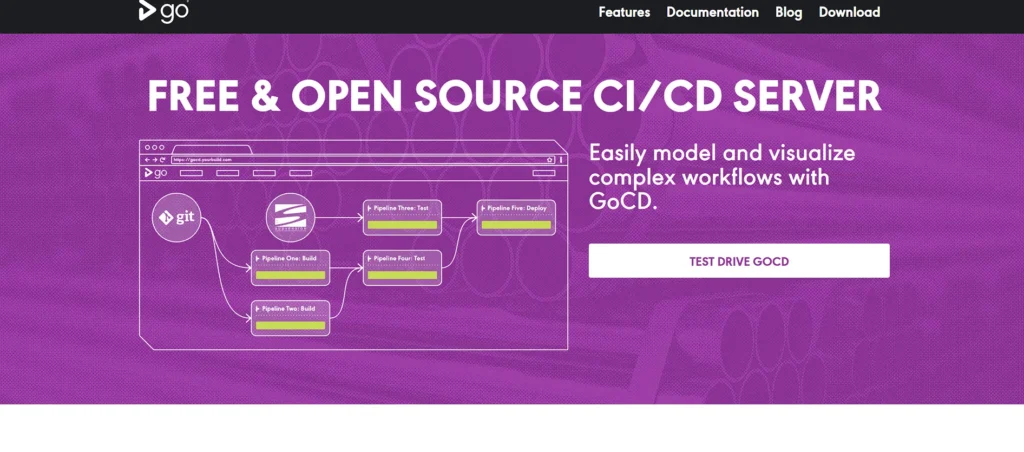
GoCD is an open-source continuous delivery (CD) and release management system created by ThoughtWorks that is tailored to automate complex software delivery pipelines with very high visibility and traceability. In contrast to traditional CI tools, which are mostly based on the principles of building and testing, GoCD is efficient in modeling complex workflows, including parallel and sequential steps, fan-in/fan-out relationships, and value stream mapping, which can help teams to comprehend the whole route of the code commit to the actual production release in real-time.
Its agent-based system decouples the central server (with configuration, pipeline orchestration, and web interface) with elastic agents that run jobs in varied environments, platforms, and versions, making it scalable and doing away with bottlenecks by trivial parallelization.
Key Features:
- End-to-end pipeline visibility and dependency tracking Value stream mapping.
- Configuration management and version control, Pipeline-as-code.
- Fan dependency/ fan-out dependency management to eliminate duplicative builds.
- Scalable, platform, and branch- parallel execution agent.
- Manual approval gates and any version on demand with audit trails.
- Artifact promotion so that binaries are tested before deployment.
- Comparison to troubleshoot files, commits, and deployment contents.
- Plug-in architecture to support integrations such as Docker, Kubernetes, and Helm.
- Advanced strategies such as blue-green, canary, and automated rollbacks are supported.
Pricing:
- Open Source
Website: https://www.gocd.org/
12. Spinnaker
Website: https://spinnaker.io
Spinnaker is a free, multi-cloud, high-velocity continuous delivery system and a powerful application deployment tool aimed at enabling software deployment to be safe, fast, and high-confidence. It allows application changes to be deployed reliably across multiple environments such as AWS, Google Cloud, Azure, Kubernetes, and on-prem systems without vendor lock-in.
Spinnaker supports safe deployment strategies including red/black (blue/green), canary, and rollback, and is commonly used to orchestrate pipelines for artifact creation, image baking, verification, and recovery. It also enables GitOps-style deployments, multi-cluster management, scalable operations, and automated runbooks to minimize deployment risks and improve operational efficiency.
Key Features:
- Automated pipeline staging that creates, bakes, deploys, verifies, and rolls back, and plans, such as blue/green, canary, and rolling updates.
- Git policy is a policy implementation that works with Git/JSON/YAML files as pipeline-as-code and version control.
- Deployment check and post-deployment health checks, which are automated.
- CI/CD CI integrations of Jenkins, Travis CI, Git triggers and CRON to cooperate.
- None of the CLI dependency multi-tenancy, UI-only, governance (RBAC, SSO, auditing), and container management.
- GitOps and managed models of description of desired infrastructure states in YAML.
Pricing:
- Spinnaker core is free Apache 2.0 and has no paid plans on its site (spinnaker.io), but is self-hosted on Kubernetes or Helm; it may have a tailored charge on enterprise support or managed service (e.g., using OpsMx or Armory), but is third-party.
Comparision Table
| Tool | Best For | Deployment Type | Key Strengths | Pricing Model |
|---|---|---|---|---|
| GitHub Actions | GitHub-based projects | Cloud / Self-hosted | Native GitHub integration, event-based workflows, large action marketplace | Free & Paid |
| GitLab CI/CD | End-to-end DevSecOps | Cloud / On-Prem | Built-in CI/CD, security scanning, environment tracking | Free & Paid |
| CircleCI | Fast cloud CI/CD | Cloud / Self-hosted | Parallel jobs, Docker-first approach, reusable orbs | Free & Paid |
| AWS CodeDeploy | AWS-native deployments | Cloud / Hybrid | Blue-green & canary deployments, AWS ecosystem integration | Mostly Free (usage-based) |
| Azure DevOps Pipelines | Microsoft ecosystem users | Cloud / On-Prem | Multi-platform support, strong Azure integration | Free & Paid |
| Docker | Container-based apps | Cloud / On-Prem | Portable containers, fast scaling, Docker Hub registry | Free & Paid |
| Argo CD | Kubernetes & GitOps | Cloud / On-Prem | Declarative GitOps, drift detection, multi-cluster support | Free (Open Source) |
| Octopus Deploy | Complex release management | Cloud / On-Prem | Multi-tenancy, approvals, rollback-friendly deployments | Free & Paid |
| Chef | Infrastructure as Code | Cloud / On-Prem | Configuration automation, compliance, large-scale infra | Paid |
| Puppet | Large enterprise automation | Cloud / On-Prem | Declarative configs, strong reporting, scalability | Free & Paid |
| GoCD | Complex delivery pipelines | Cloud / On-Prem | Pipeline visualization, dependency tracking | Free (Open Source) |
| Spinnaker | Multi-cloud deployments | Cloud / Hybrid | Advanced deployment strategies, high scalability | Free (Self-hosted) |
Conclusion
The software releasing world, with its complexity, is simplified into smooth and automatic operation with the help of application deployment tools, such as GitHub Actions, GitLab CI/CD, Docker, and others, resembling a home-cooked cake turning into the perfect dish offered to the whole crowd. These tools enable both developers and digital marketing experts to concentrate on innovations instead of server issues, by reducing release times and error counts, and increasing team efficiency, with such functions as CI/CD pipelines, rollbacks, and scalability, guaranteeing the consistently high-speed, high-availability deployment of applications to the cloud, on-prem, or hybrid environments.
The selection of the best one is limited to the requirements of your project, the abilities of your team, and your budget. Begin with a proof-of-concept test to open the door to rapid cycles, low downtime, and a machine that works with DevOps smoothly and can be scaled without any effort.
FAQ
Q.1 Why Use Deployment Tools?
These tools cut down the deployment time from hours to minutes, cut down the downtime, and offer consistency on the interteam. They not only reduce human error but also automate repetitive tasks and make it scaled to more applications. The teams that get the most help from faster iterations are DevOps teams.
Q.2 How Do They Differ From CI Tools?
CI tools are also interested in code development and testing, whereas deployment tools already test artifacts are delivered to the production environment in such ways as rolling updates. The two are combined by most of them, including Jenkins or GitHub Actions, and cross the boundary. Deployment is concerned with the observability and post-release safety.
Q.3 Which Deployment Strategies are Supported?
The common ones are blue-green (no downtime switches), canary (no downtime switches), and rolling updates. Here, we may use Spinnaker or Argo CD, where a safe test on a small group of users can be conducted before the complete release.
Q.4 Do We Have Any Free Choices?
Indeed, free plans of such open-source tools as Jenkins, Ansible, or GitHub Actions offer powerful functionalities. It may have limitations of use on the enterprise level, but it will be useful in small groups or startups. Upgrades are charged in order to allow additional support and scaling.
Q.5 What Integrations Tend To Be Common?
Most of them are used in conjunction with GitHub, GitLab, AWS, Azure, and Docker to have version control and containers. The tools like Buddy or Octopus Deploy are connected with Jenkins or end-to-end pipelines monitoring services.
Q.6 What Are The Pros and Cons?
Benefits: Automation makes releases faster, is more scalable, and reduces the overall cost in the long-term. Cons: YAML has a learning curve, per-scale costs, and configuration time of complex stacks. GitHub Actions is optimally used by Git users, and no external repo can be viewed.
Q.7 How To Choose The Right Tool?
Simple projects are supposed to use Buddy depending on the size of the team, on the utilisation of the clouds, and on the already existing stack; big companies are supposed to use Kubernetes or Spinnaker. Free trial of community support and integration. Focus more on ease of use in order to be adopted more quickly.