
In the dynamic world driven by advances in the digital age, companies are continually seeking ways to simplify their marketing processes and achieve high efficiency and better returns. Marketing Automation Software has become a revolutionary tool to help businesses automate their marketing processes, and quite repetitive, nurture their leads, and provide them with personalized experiences on a mass scale.
This end-to-end technology enables organizations to develop highly advanced marketing efforts that are made to run smoothly in the background and ensure marketing departments are able to concentrate on strategic initiatives as opposed to manual ones. We move towards the year 2026, and Automation software becomes more and more sophisticated with its features that allow businesses of any size to reach their sales goals and preserve valuable customer relationships.
What is Marketing Automation Software?
Marketing Automation Software is an advanced technology platform that automates, streamlines, and measures marketing activities and processes of multi-channel marketing efforts. This is a potent tool that allows businesses to assign personal customer journeys through automated delivery of targeted messages, triggered, behavioral, and demographic-based. Fundamentally, Automation Software integrates customer relationship management features and high-end analytics to ensure that the customer is provided with the right message, at the right time, and to the right customer.
Benefits of Marketing Automation Software
- Time and Cost Savings: Eliminates manual processes and operation costs and enhances the productivity of the marketing teams and the speed with which campaigns are executed.
- Personalization at Scale: Provides specific experiences to thousands of customers at the same time, without the necessity to hire a manual process and customize each one of them.
- Raised Sales and Marketing Synergy: Will provide a common understanding of lead quality and prospect development within the customer pipeline, enhancing collaboration between teams.
- Data-Driven Decision Making: Offers a detailed analytics solution and market understanding to enable marketers to make the right decisions and even optimize the campaigns in a continuous manner.
- Increased Conversion Rates: It increases the conversion rates between leads and actual customers by making use of targeted messaging, maximum timing, and powerful nurturing sequences.
How to Choose the Right Marketing Automation Software
- Business Needs and Goals: Before deciding on which platform to adopt, it is critical to reexamine its current marketing objectives, firm growth demands, and specific automation demands.
- Consider Integration: Capabilities, such as that with your existing CRM, location, and social media platforms, among other items your business needs.
- Usability and Learning: Select an interface that your employees find easy to use and do not require special training as well as ensuring that they do not need to be advanced computer users.
- Pricing and Scalability: Review the pricing and scaling options available today, and to the future, to make the proper decision to ensure you can grow with your business as it changes.
- Customer Support and Training Resources: look for vendors that will offer substantial onboarding and support, and training materials to leverage your purchase.
Top 10 Marketing Automation Software in 2026
1. HubSpot Marketing Hub
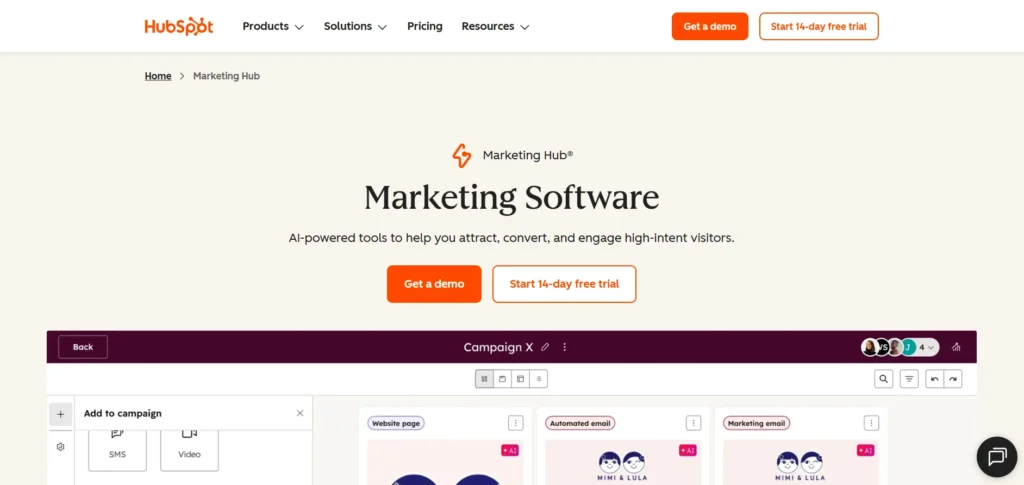
HubSpot tools like Auto Post have become some of the most powerful and convenient solutions in today’s marketing automation landscape.. This end-to-end product features strong automation software with a user-friendly interface that makes it easy to use by businesses of any size. It has a powerful free-tier and a scalable paid program, which lets it appeal to both startups and large businesses. The uniqueness of HubSpot is that there is a smooth integration of marketing, sales, and service hubs, resulting in a combined customer experience management system.
Its robust set of templates, workflow, and learning materials provided by the platform enables businesses to go to market fast, but with the richness required when implementing advanced marketing operations. HubSpot Marketing Hub is one of the leading marketing automation tools that can be recommended to any business because it is based on major inbound marketing methodology principles and is constantly developing.
Key Features:
- Drag-drop workflow builder
- Advanced lead scoring
- Comprehensive analytics dashboard
Pros:
- User-friendly interface design
- Excellent free tier
- Strong integration ecosystem
Cons:
- Premium features expensive
- Limited customization options
- Steep learning curve
Pricing: ₹66,697/mo
Website: https://www.hubspot.com/products/marketing
2. Salesforce Marketing Cloud
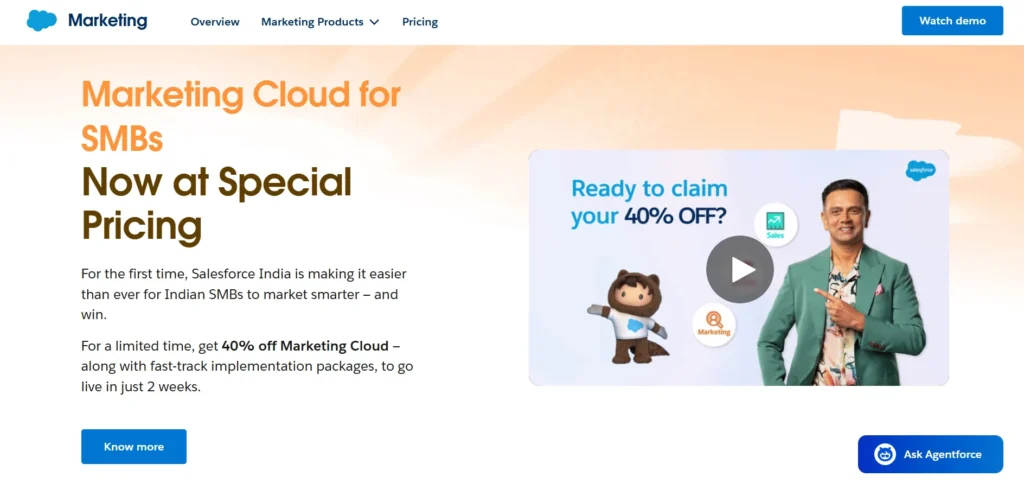
The Salesforce Marketing Cloud is the most advanced version of enterprise marketing automation, and the extreme version is the one that is used when there are big companies with byzantine marketing requirements. This is a potent platform offering AI-driven forecasted inferencing, predictive insights, and cross-channel orchestration that can manage high volumes of data and complex customer paths. The solution has the advantage of being easily migrated into the wider Salesforce ecosystem, producing a fresh perspective of customer interactions in sales, service, and marketing realms.
The Marketing Cloud, with its powerful API structure and wide 3d party app store, can be configured to any business need. Einstein AI features in the platform offer smart suggestions, optimal send times, and audience insights and predictions to assist marketers in executing more successful campaigns. Although the learning curve is steep and implementation is heavy on resource requirements, the returns on the investment of large enterprises are very large.
Key Features:
- AI-powered campaign
- Cross-channel journey
- Advanced tools
Pros:
- Enterprise-grade scalability
- Powerful AI features
- Extensive customization options
Cons:
- High implementation costs
- Complex setup process
- Requires technical expertise
Pricing: Custom pricing starting around $1,250/month
Website: https://www.salesforce.com/in/marketing/
Suggested Read: Product Lifecycle Management Software
3. Marketo Engage (Adobe)
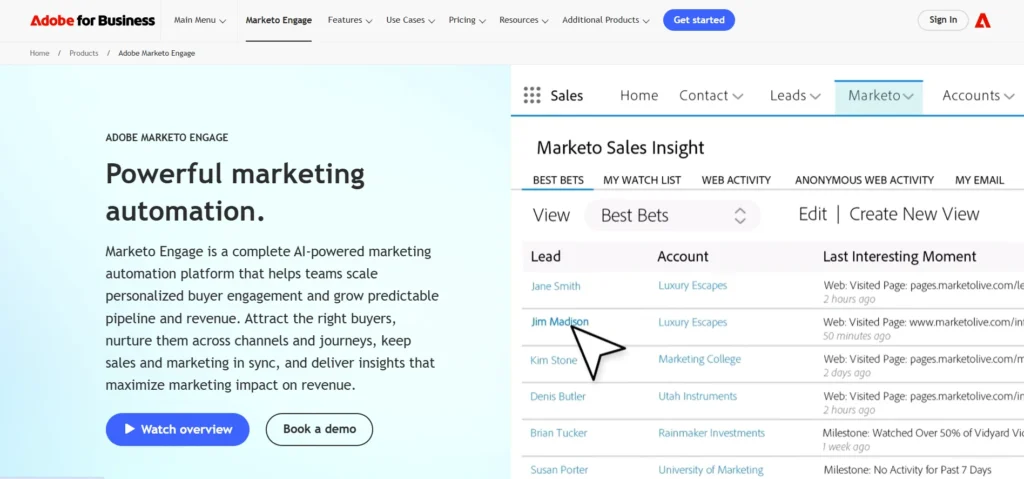
Originally named Marketo and recently acquired by Adobe Experience Cloud, Marketo Engage offers advanced marketing automation to B2B companies and companies with long sales cycles. This more mature platform specializes in lead management, account-based marketing, and revenue attribution, so it may be a better fit for companies that have a longer timeframe to turn prospects into customers. The power in the software is the sophisticated lead scoring models, customer journey maps, and integration with such crm systems as Salesforce. Campaign management tools available in Marketo are highly specific and give marketers the ability to develop finely detailed marketing workflows that react to subtle customer behaviors.
Its reporting and analytics solutions give marketers a profound insight into how the campaigns are performing and how the revenue is affected, enabling them to be able to establish proper ROI. With the support of Adobe, Marketo is growing, equipped with more AI features and an intuitive user experience, but it is still limited to scenarios where the marketing functions of an organization have specific resources allocated to them.
Key Features:
- Advanced lead management
- Revenue attribution modeling
- Account-based marketing tools
Pros:
- Powerful B2B features
- Excellent CRM integration
- Comprehensive reporting capabilities
Cons:
- Steep learning curve
- High pricing tiers
- Complex initial setup
Pricing: Custom pricing starting around $1,195/month
Website: https://business.adobe.com/products/marketo.html
4. ActiveCampaign
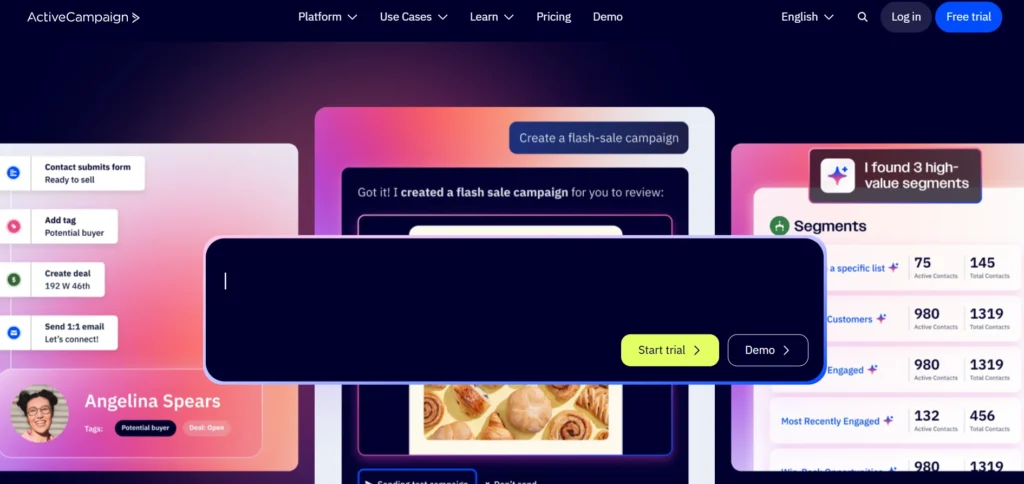
ActiveCampaign achieves a perfect balance between automation features and simplicity of administration, which is why its service is optimal both in cases where businesses expand and require advanced functionality without it becoming too complicated. The platform integrates all features of marketing automation, email marketing, sales automation, and CRM in a unified platform that scales with your business. The visual builder of automations in ActiveCampaign enables users to easily construct multifaceted customer journeys, and its machine learning engine assists with optimising send time and predicting customer action.
The platform has especially excelled in integrations with e-commerce, providing pre-built automations to recover abandoned carts, make product recommendations, and manage the customer lifecycle. ActiveCampaign stands out with its competitive pricing and superb customer service to become a favorite of small-to mid-sized companies interested in integrating professionally supplied marketing automation. The split-testing feature and in-depth reporting on the platform also allow marketers to continuously tweak their ideas until they get the best results.
Key Features:
- Visual automation builder
- Machine learning optimization
- E-commerce integration suite
Pros:
- Excellent price-to-value ratio
- Intuitive user interface
- Strong customer support
Cons:
- Limited enterprise features
- Reporting could improve
- Template design limitations
Pricing: Plans start at $15/month for up to 500 contacts
Website: https://www.activecampaign.com/
5. Mailchimp
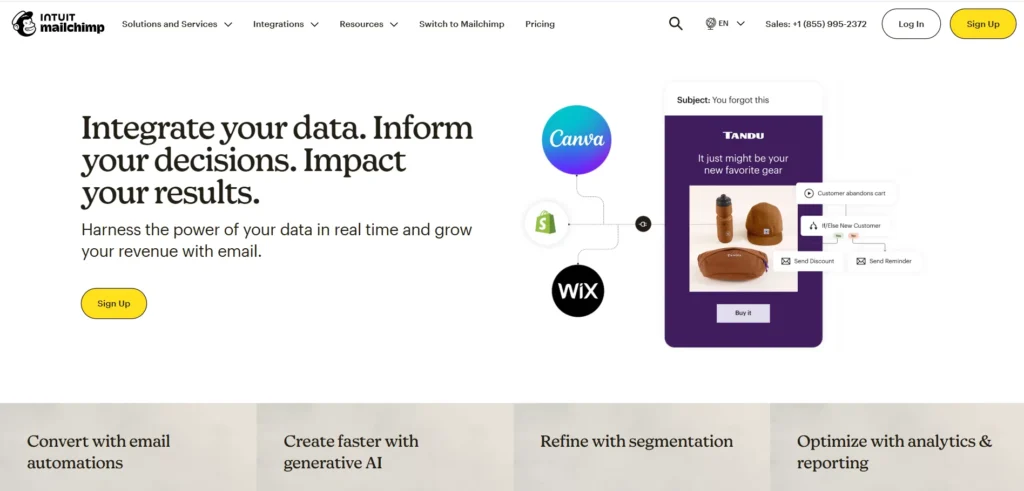
Mailchimp successfully emerged to be a full-fledged marketing automation tool with millions of businesses using Mailchimp across different regions. Known for its ease of approachability and the great onboarding experience, Mailchimp brings the use of marketing automation to a wide array of businesses that lack technical skill or the marketing means to spend a substantial budget on a marketing solution.
It is highly affordable with a substantial free plan with essential automation capabilities, and therefore represents a perfect place to start with small businesses and start-ups. The advantage of using Mailchimp is that it is easy to use and relies on the necessary automation tools, such as welcome series, abandoned cart email, and customer journey maps are available but do not confuse the user with their complexity.
The integration marketplace at the platform gives access to hundreds of the most popular business tools, and the analytics are built in, allowing the user to understand the rate of performance and engagement of their campaign. More recent enhancements, such as more advanced segmentation, predictive analytics, and even more robust e-commerce functions, have seen Mailchimp become a viable platform choice for growing businesses that want to easily handle their marketing automation efforts.
Key Features:
- Drag-and-drop email builder
- Audience segmentation tools
- E-commerce automation templates
Pros:
- User-friendly interface
- Generous free plan
- Excellent deliverability rates
Cons:
- Limited advanced features
- Pricing increases quickly
- Basic reporting capabilities
Pricing: Free plan available; paid plans start at $13/month
Website: https://mailchimp.com/
Suggested Read: World Best Business Opportunity List
6. Zoho Marketing Automation
Zoho Marketing Automation is convincing due to being a low-cost service that fits into the rest of the available business software in Zoho, forcing companies using the Zoho CRM, Zoho Sales or Zoho productivity products. This platform provides all required attributes of marketing automation at affordable prices with the focus on functionality of the features rather than nonsense. The benefit of Zoho is that marketing automation is integrated into one system to operate businesses, and it does not overlap with the use of such tools as sales, customer service, and project management.
It has good email marketing features, lead scoring, and control over social media with the basic analytics, which best fits the needs of small and medium enterprises. Zoho marketing automation is arguably not the most comprehensive with its functionality but it is a firm low-to-mid-market system that performs well and is reasonable in pricing.
The multi-language feature of the solution and the global availability make it attractive to international businesses in particular, and the concept of clear pricing with a single method of billing helps organizations properly prepare when budgeting their marketing technology stack.
Key Features:
- Unified business suite
- Multi-language campaign support
- Social media automation
Pros:
- Affordable pricing structure
- Seamless Zoho integration
- Global accessibility features
Cons:
- Limited advanced features
- Basic template designs
- Smaller user community
Pricing: Plans start at $12/month for up to 500 contacts
Website: https://www.zoho.com/marketingautomation/
7. Pardot (by Salesforce)
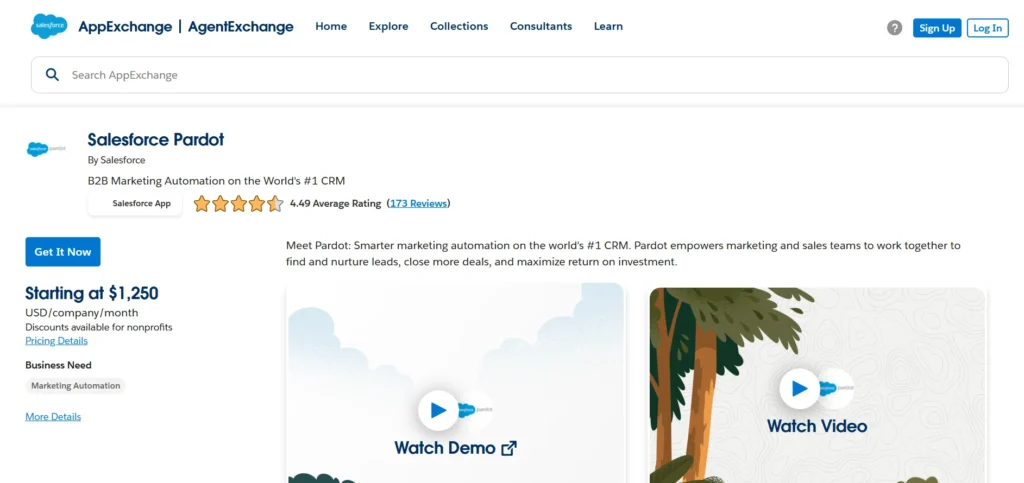
Salesforce B2B marketing automation platform Pardot is specifically designed to serve those organizations that have a complex sales process and a longer buying cycle. It is an advanced product that excels in lead qualification, account-based marketing, and sales-marketing alignment and thus is of particular interest to B2B companies with a dedicated marketing operations team. The biggest asset of Pardot is that it works intensively with the Salesforce CRM, and this integration provides a smooth exchange of information between marketing and sales departments.
The platform has new capabilities such as progressive profiling, dynamic content, and lead scoring modelling to ensure that high-quality leads ready to be sold are identified. Pardot ROI reporting features report all the details of the attribution analysis, allowing marketing teams to prove the contribution they make to revenue generation.
The multi-business unit, sophisticated approval procedures, and the enterprise-level security needs make the solution suitable for larger organizations. It is, however, difficult to operate and somewhat expensive as such that small businesses will not find it easy to operate, and as such, a huge outlay in training and implementation resources will be required.
Key Features:
- Advanced lead qualification
- Deep Salesforce integration
- ROI attribution reporting
Pros:
- Powerful B2B features
- Excellent sales alignment
- Enterprise security standards
Cons:
- High learning curve
- Premium pricing model
- Complex implementation process
Pricing: Custom pricing starting around $1,250/month
Website: https://www.salesforce.com/in/
Suggested Blog: Best LinkedIn Marketing Tools
8. Keap (Infusionsoft)
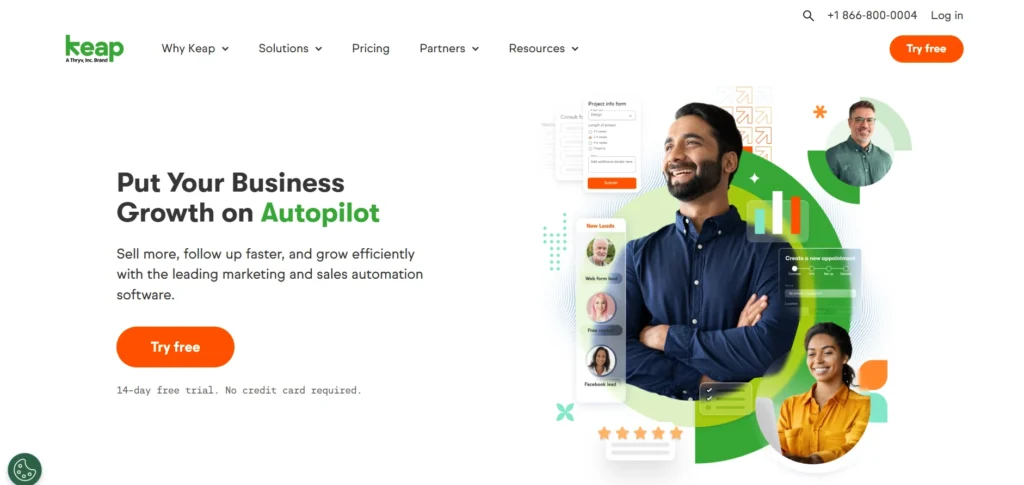
Keap, known in the past as Infusionsoft, has established a niche in the market of marketing automation with its specialization in the requirements of small companies and entrepreneurs. The platform has a mixed marketing automation, customer relationship management(CRM), and e-commerce solution that works to enable the growing business to establish order within its operations and scale accordingly.
Keap has a visual campaign builder that lets users build even the most complicated automation easily without technical knowledge, as well as an integrated CRM that supports customer relations and sales. The platform is especially strong in service businesses, where it has capabilities such as appointment scheduling and invoice creation and processing, in addition to more conventional functionalities of marketing automation.
The educational materials, as well as coaching practice provided by Keap, enable small business entrepreneurs to apply successful marketing approaches in practice, and it is not merely a piece of software. Although Keap might not have some of the more advanced tools that are shared by enterprise solutions, its targeting of small business marketing requirements and its one-stop shop approach make it both interesting and appealing to entrepreneurs who wish to take their marketing to the next level.
Key Features:
- All-in-one business platform
- Visual campaign builder
- Integrated payment processing
Pros:
- Small business-focused
- Comprehensive feature set
- Excellent customer education
Cons:
- Limited scalability options
- Outdated user interface
- Higher learning curve
Pricing: Plans start at $249/month
Website: https://keap.com/
9. GetResponse
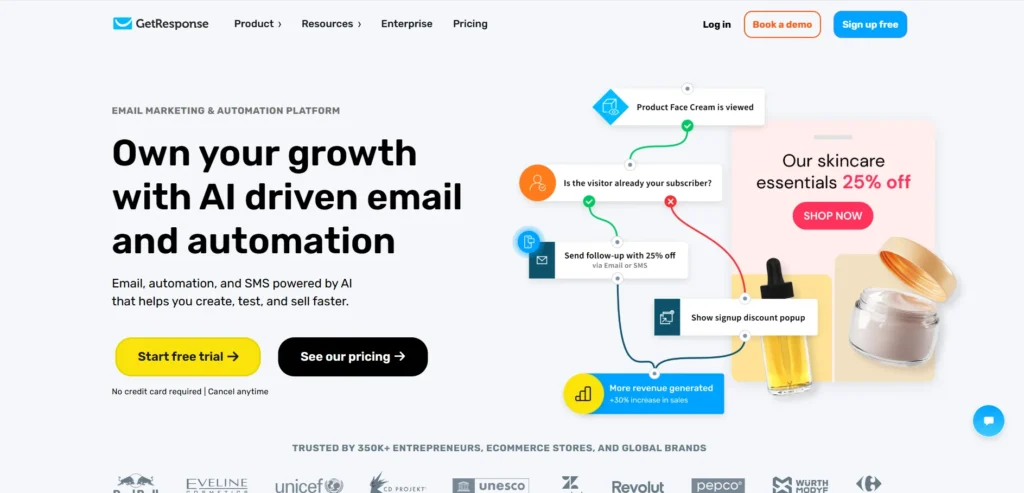
GetResponse has become a multi-functional and reasonably priced marketing automation system that manages to find a middle ground between simple email marketing tools and complex enterprise-scale offerings. This Polish-based firm has established a reputation for offering good performance and innovative features at a competitive price. The automation builder in GetResponse is simple, but capable enough that you can make very complex workflows without a high level of technical knowledge. Some of the distinctive commercial characteristics of the platform are webinar hosting, landing pages, and conversion funnels.
The tools offered by GetResponse are AI-driven, so send times, subject lines, and content suggestions can be optimized, and its advanced segmentation guarantees a message is delivered to the right audience. A wide international coverage, with high deliverability and adherence to worldwide data protection laws, underlines the platform. Its package of marketing robotization and webinar options, as well as e-commerce functions, makes it a great deal even for companies that want to have an extended marketing platform at a reasonable price.
Key Features:
- Integrated webinar platform
- AI-powered optimization tools
- Conversion funnel builder
Pros:
- Competitive pricing model
- Unique webinar features
- Excellent deliverability rates
Cons:
- Limited enterprise features
- Basic CRM functionality
- Fewer integration options
Pricing: Plans start at $19/month
Website: https://www.getresponse.com/
10. Sendinblue (Brevo)
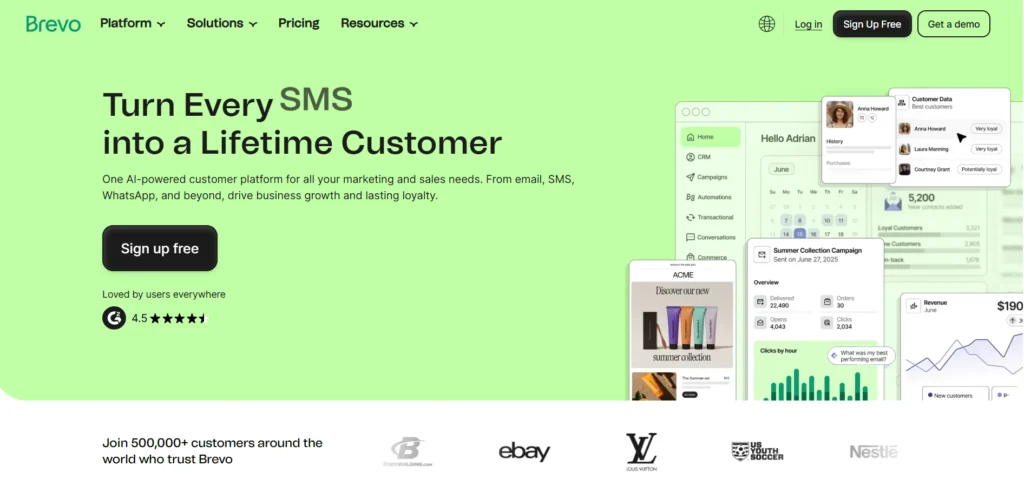
New marketing automation platforms, Europe-based Sendinblue (and now Brevo), feature data privacy, GDPR compliance, and transparent pricing models. Many businesses have taken to this platform largely because it provides a dependable marketing automation platform without the complexity and high cost involved in enterprise solutions. Brevo is a powerful solution in its simplest form of automation, with email marketing, text message campaign, and chat side by side in one platform. The visual workflow builder in the software is clean and easy to understand, allowing a non-technical user to easily establish competent automation chains.
Brevo is specifically strong in transactional email delivery with advanced infrastructures that reliably deliver business-critical messages to the intended audience. The pricing model of the platform consists of the number of sent emails instead of the number of stored contacts and is therefore a more economical model to use with a business involving a large database, yet with fewer emails. Brevo, with its commitment to simplicity, reliability, and compliance, can be a great alternative to businesses that care about the straightforward marketing automation with high email deliverability.
Key Features:
- SMS marketing integration
- Transactional email delivery
- Chat and customer support
Pros:
- Transparent pricing model
- Strong GDPR compliance
- Excellent deliverability rates
Cons:
- Limited advanced automation
- Basic reporting features
- Fewer third-party integrations
Pricing: Free plan available; paid plans start at $25/month
Website: https://www.brevo.com/
Also Read: Top Password Manager Software
Conclusion
Marketing Automation Software has emerged as the sought after piece of equipment as adopted by businesses to flourish in the contemporary competitive climate of the digital environment. Their platforms, as we have mentioned in this final guide, involve transformational functionality that can optimise marketing processes, have a customer experience amplification and result in quantifiable business growth.
The Automation Software technologies are even more fast-paced and artificial intelligence, machine learning, as well as advanced analytics are changing how companies can be engaged with their audience.
In order to make Automation Software a success, one should focus on the selection of the platform, a smart implementation, and constant optimization. Any business can leverage the power of automated marketing methods, using their features, benefits, and best practices described in this guide, and use these tools to inform their marketing technology investment to achieve their business objectives.
Frequently Asked Questions
Which is the greatest marketing automation for small businesses?
ActiveCampaign and HubSpot Marketing Hub can be the most appropriate options when it comes to small businesses because of their simple interface, reasonable prices, and set of extensive functionality.
What is the improvement of ROI with Marketing automation?
Marketing Automation Software enhances ROI since it enhances efficiency, lowers manual labour, and delivers target messages to enhance conversion rates. Automated lead nurturing will boost sales-ready leads by as much as 50 percent and decrease cost-per-lead by 33 percent.
Is marketing automation reserved for large firms?
No, Marketing Automation Software can be useful to any business of any scale. There is a considerable number of platforms with cheap plans, especially targeting small businesses and startups. The third-party tool, such as Mailchimp, ActiveCampaign, and GetResponse, has strong automation capabilities at affordable prices.
How do CRM differ from marketing automation?
Although both of the systems have the functions of handling customer relationships, Marketing Automation Software is concerned with helping to attract, nurture, and convert prospects by means of automatic marketing campaigns, whereas CRM systems are mainly used to handle existing customer relationships and sales activities.
What is the price of marketing automation software?
The Marketing Automation Software pricing differs greatly according to features, the number of contacts in the database, and the complexity of the platform. The minimum-level plans begin at approximately $15-25/month and smaller enterprises, and the mid-tier alternatives begin at about $50-200/month.